If you run a business tied to one city, a city TLD domain is a smart move. It signals location instantly, often gets you a shorter name than .com allows, and builds instant local credibility. If you're building a national or global brand, skip it. .vegas is wide open and built for exactly this kind of branding, .nyc carries serious trust because of its address requirement, and .berlin has community backing that gives it staying power.
Pick a city TLD if you're a local retailer, a tourism operator, an event brand, or a neighborhood service. Skip it if you're a national chain, a multi-state operation, or an e-commerce brand shipping coast to coast.
- Go local: restaurants, wedding planners, tour operators, real estate agents
- Stay national: franchises, SaaS companies, anything selling beyond one metro area
- Hybrid case: brands testing a city market before expanding elsewhere
Key Takeaways
A city TLD domain earns its cost for single-location, place-based businesses, but it never replaces the local SEO work of citations, Google Business Profile, and backlinks.
| Point | Details |
|---|---|
| Match the TLD to your footprint | Choose a city TLD only if your business genuinely serves one metro area. |
| Check nexus rules early | Confirm address or documentation requirements before you fall in love with a name. |
| Budget for renewal, not just signup | Promotional first-year pricing rarely matches the standard renewal rate. |
| Treat the TLD as one signal, not a strategy | Pair it with GMB, citations, and local backlinks for real SEO impact. |
| Consider leasing for premium names | A brokered lease or purchase can secure a strong .vegas name without open-market bidding. |
Table of Contents
- What Are City TLD Domains, and Which Ones Are Popular?
- How Do You Register a City TLD Domain?
- What Are the Eligibility and Verification Rules?
- When Does a City TLD Actually Make Sense?
- What Do City TLD Domains Cost, and Where Should You Buy One?
- City TLD vs. Subdomain vs. Subdirectory vs. .com
- What Pitfalls Should You Watch For?
- Why .VEGAS Works: A First-Party Case Study
- What the Data Actually Tells You About City TLDs
- Sources
What Are City TLD Domains, and Which Ones Are Popular?
A city TLD is a top-level domain tied to a specific place, like .vegas instead of .com. Registries run these under rules that range from wide open to strictly local. IANA's root zone database lists every delegated city TLD, and the roster is bigger than most people expect.
Here's a quick scan of the names that matter most, and what to know before you register one:
- .vegas — Open registration, no residency proof needed, built for hospitality, events, and entertainment branding.
- .nyc — Requires a New York City address at signup, according to NYC's Office of Technology & Innovation, which keeps the namespace tightly local and trustworthy.
- .london — Open registration, popular with UK-facing businesses and creative agencies.
- .tokyo — Open registration but strongly associated with Japan-based brands.
- .berlin — Community-sponsored and aimed at Berlin citizens, companies, and institutions; it launched in 2014 and passed 59,000 registrations by 2017.
- .miami — Open registration, common among real estate and tourism sites.
- .boston — Open registration, smaller adoption than coastal peers.
- .paris — City-run registry with promotional ties to Paris tourism and civic branding.
- .amsterdam — Backed by a pioneer ambassador program that ICANN highlights as a model for driving local adoption through city partnership.
Adoption varies widely. Digital City Brands' 2021 analysis ranks .berlin, .tokyo, and .nyc among the top performers on registration counts and active site usage, proof that a well-run registry with civic buy-in outperforms an open free-for-all.
How Do You Register a City TLD Domain?
Registration follows a predictable path, but skipping a step can cost you the name or your money.
- Pick your name and check availability across the city TLD and .com. A shorter name is often available under a city TLD precisely because .com scarcity doesn't apply there.
- Read the registry's eligibility policy. Some, like .nyc, require a local address. Others, like .vegas, are open to anyone.
- Choose a registrar that supports the registry and compare renewal pricing, not just the first-year rate.
- Gather verification documents in advance: proof of address, a business license, or local ID, depending on the registry.
- Complete registration and set a renewal reminder. Promotional pricing rarely carries into year two.
Pro Tip: Before you commit, search the registrar's own renewal price page, not just the checkout screen. Promotional first-year pricing is common across the industry, and the jump at renewal can surprise you if you don't check it first.
What Are the Eligibility and Verification Rules?
"Nexus" is registry-speak for a required connection to the place your domain names. Rules vary a lot from one city TLD to the next.
- .nyc requires a New York City postal address at registration, confirmed by NYC's OTI.
- .london asks for a UK connection, though enforcement is lighter than New York's.
- .tokyo leans toward a Japan-based presence, though it's technically open.
- .vegas, .miami, and .boston have no residency requirement at all.
Verification usually happens at checkout, where the registrar collects documentation and passes it to the registry for approval. Some registrants try virtual mailbox addresses to satisfy nexus rules, but that can violate a registry's terms of service and put the domain at risk of suspension. Weigh that risk before you lean on a workaround.
When Does a City TLD Actually Make Sense?
A city TLD earns its keep for businesses whose entire identity is tied to one place: restaurants, tour operators, wedding vendors, neighborhood clinics, and local news outlets. It's a poor fit for national retailers, global startups, or any brand serving customers who don't care what city you're headquartered in.
- Strong fit: local hospitality, tourism, event planning, neighborhood services
- Weak fit: national e-commerce, multi-location franchises, software companies selling everywhere
On SEO, keep your expectations grounded. A city TLD sends a geographic relevance signal, but it's not a standalone ranking factor; it still needs to be paired with Google Business Profile listings, local citations, and local backlinks to move rankings. The real trade-off is cost versus branding: you'll often find a shorter, punchier name than .com offers, but renewal prices run higher and the resale market is thinner. Digital City Brands shows the highest-performing city TLDs pair strong registration counts with active promotion from the city itself, not just open availability.
What Do City TLD Domains Cost, and Where Should You Buy One?
Most city TLDs follow the same pricing pattern as any other domain extension: a discounted first-year rate followed by a standard renewal that can run noticeably higher. Some, like .nyc, price at a premium tier reflecting the added verification and local exclusivity. Registrar and price-aggregator sites track more than three dozen city domain extensions, and prices swing widely between resellers for the same exact name.
- Compare renewal pricing across at least two or three registrars before buying, not just the promo rate.
- Check whether the name you want is premium-priced (common for short, high-demand strings).
- For high-value names already registered, a domain broker can negotiate a private sale or lease on your behalf.
- If you want a .vegas name specifically, leasing through GET YOUR VEGAS sidesteps the open marketplace entirely.
City TLD vs. Subdomain vs. Subdirectory vs. .com
The right structure depends on how many locations your business has and where it's headed.
- Single-location business: a city TLD gives the strongest local signal and branding clarity.
- Multi-location chain: a subdirectory (yourbrand.com/city) keeps domain authority consolidated under one root.
- National brand with local outposts: stick with .com and use city-specific landing pages, not separate domains.
- Testing a new market: a subdomain (city.yourbrand.com) is cheap and easy to retire if the test fails.
Cost and complexity rise as you move from subdirectory to subdomain to a standalone city TLD, but so does the branding payoff for a genuinely local business.
What Pitfalls Should You Watch For?
Renewal price hikes catch more registrants off guard than any other issue. A domain priced at $15 for year one can jump to $40 or more at renewal, and some registries offer little support if you feel misled about SEO promises tied to the extension.
- Read the registry's terms of service before relying on a virtual address to meet nexus rules.
- Run a trademark search before registering, especially for names close to existing brands.
- Set automatic renewal and calendar a manual check each year against current market pricing.
Pro Tip: Save a copy of every verification document you submit at registration. If a registry asks for reverification later, having it on hand saves a scramble.
Why .VEGAS Works: A First-Party Case Study
GET YOUR VEGAS has specialized in .VEGAS domains since 2009, handling leasing, sales, auctions, and consulting for businesses that want a local identity without the guesswork. Clients like WEDDINGS.VEGAS show what a well-matched name does for brand clarity: the domain tells visitors exactly what the business offers and where, before they click a single link.
A domain that states your business and your city in five letters does more branding work in a glance than a paragraph of copy ever could.
Whether you lease, buy outright, or work through a broker depends on how urgently you need the name and how much long-term flexibility you want.
- Lease if you want a premium .vegas name without a full purchase commitment.
- Buy outright via Make an Offer if you're building a permanent brand asset.
- Pair it with billboard advertising for integrated local campaigns that reinforce the domain offline.
Ready to see what's available? Explore leasing options and find the .VEGAS name that fits your brand.
What the Data Actually Tells You About City TLDs
Most advice on city TLDs treats every extension like it's interchangeable, and that's the biggest blind spot in this space. A .nyc registration backed by a real address requirement carries more trust weight than an open .vegas registration with zero barriers to entry, and that difference matters when you're deciding how much branding credibility a domain alone will earn you.
The conventional advice to "just get a matching city domain" skips the harder question: does your business's future look like one city, or does it look bigger? A restaurant, a wedding vendor, or a tour operator rarely regrets a city TLD. A startup with ambitions past its home metro almost always does, once it has to explain to national customers why its domain says "vegas" or "nyc" when it ships everywhere.
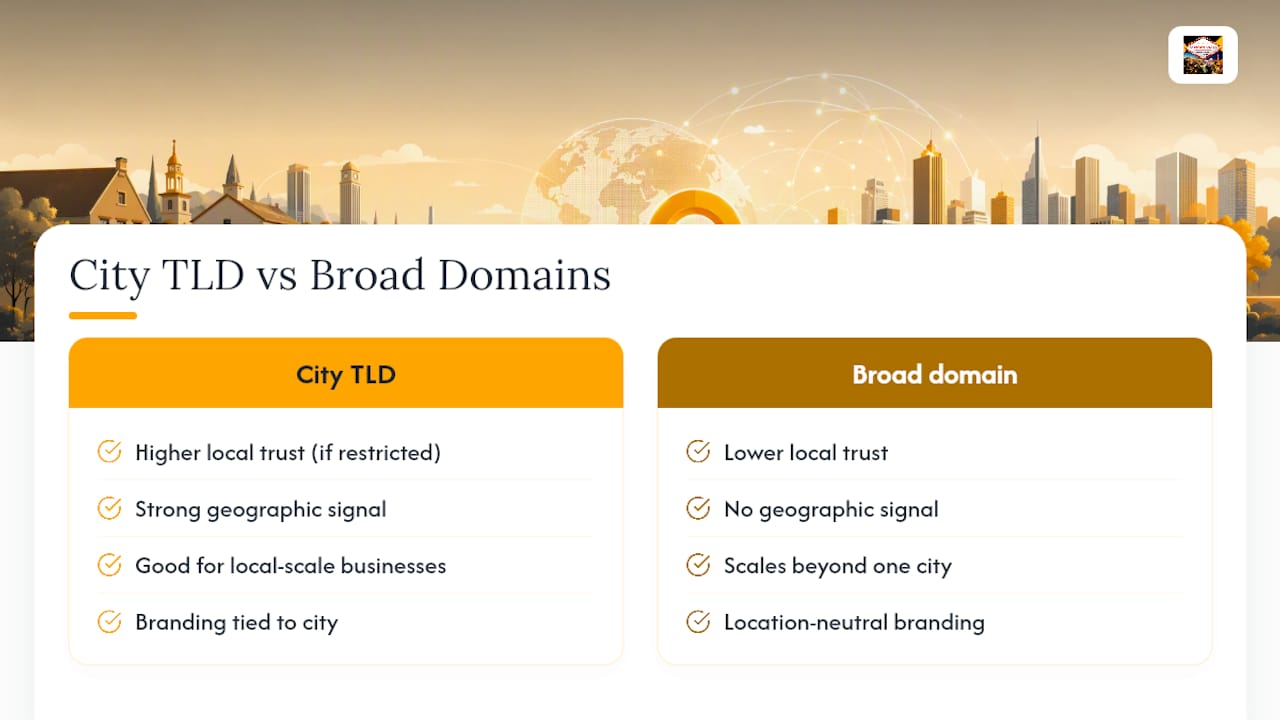
Prioritize eligibility research first, cost second, and SEO expectations third. The TLD is a branding decision dressed up as a technical one. Treat it that way and you'll pick the right name the first time.
Sources
- IANA — Root Zone Database: city
- Digital City Brands 2021 - Geotld Group
- Beyond the Dot: How .amsterdam Elevates a Global City
- NYC Office of Technology & Innovation — NYC top-level domain
- Geographic TLDs: .nyc, .london, .tokyo and Beyond — TLDfyi