
If your .VEGAS name is tied to real revenue or customer trust, defensive domain registration is worth doing. Register or lease the highest-risk lookalikes now. If your .VEGAS presence is exploratory or low-traffic, targeted monitoring is enough until the risk picture changes.
Apply these two criteria before spending a dollar:
- Brand-critical exposure: Does your .VEGAS name appear in customer-facing marketing, invoices, or booking flows? If yes, a typosquatted version could divert real transactions.
- Credible abuse scenario: Could a fake version of your domain convincingly impersonate you for phishing, fake bookings, or payment fraud? Las Vegas hospitality, events, and finance brands face this daily.
GET YOUR VEGAS has offered .VEGAS leasing, sales, and auction services since 2009, making it a practical starting point for both acquisition and ongoing portfolio management.
Table of Contents
- When is defensive registration worth the cost for .VEGAS names?
- How do you acquire .VEGAS defensive names?
- How do you prioritize which .VEGAS names to defend?
- What should you do immediately after acquiring a defensive .VEGAS name?
- What do costs and timelines look like for .VEGAS defensive names?
- How do you keep your .VEGAS portfolio protected over time?
- What defensive registration won't fix, and what else you need
- How WEDDINGS.VEGAS built brand identity with a .VEGAS domain
- Key Takeaways
- The case for targeted, not blanket, defensive registration
- Your .VEGAS brand deserves more than a placeholder
When is defensive registration worth the cost for .VEGAS names?
Defensive registration means buying domain variants you have no intention of actively developing. The goal is simple: remove the obvious impersonation targets before someone else grabs them.
For .VEGAS, the highest-risk business types are hospitality, wedding services, entertainment venues, large e-commerce operations, and any brand running paid advertising that drives traffic to a .VEGAS URL. If your marketing spend is pushing customers toward your domain, a lookalike costs you real money.
The credible abuse scenarios are specific. Typosquatting feeds phishing campaigns. Fake booking or support pages divert payments. A "billing.YOURBRAND.vegas" variant can intercept wire transfers. These aren't hypothetical threats in a market as transaction-heavy as Las Vegas.
Weigh likelihood against impact. A well-known local brand with high search volume faces higher likelihood; a brand with a complex, hard-to-misspell name faces lower likelihood. High impact means customer-facing transactions, sensitive data, or significant ad spend. Where both are elevated, register defensively. Where both are low, monitor instead.
Pro Tip: Avoid blanket purchases. A practical defensive portfolio targets misspellings, support/billing keyword additions, and the TLD variants your audience actually types — not every conceivable permutation.
How do you acquire .VEGAS defensive names?
Five routes exist, and each fits a different situation:
- Register (new availability): The name is unregistered. You claim it directly through a registrar. Fastest and cheapest. Use this for any brand-critical variant still available.
- Buy (one-time acquisition): The name is owned but for sale. You pay once and own it outright. Higher upfront cost, zero ongoing lease obligation. Best for names you want permanently.
- Lease (recurring rights): You pay periodically for the right to use the domain. Lower upfront cost, ongoing commitment. GET YOUR VEGAS's lease options are built for this route, giving brands access to premium .VEGAS names without a full purchase.
- Auction (premium/time-sensitive): Competitive bidding on high-value names. Faster than negotiation when a name is contested. GET YOUR VEGAS facilitates .VEGAS auctions for buyers ready to move quickly.
- Make an offer (brokered negotiation): You name a price; the current holder responds. Timeline varies from days to weeks. Use this when a name is held but not actively listed.
For brand-critical defensive names, leasing or buying outright gives you the fastest, cleanest control. Auctions suit high-priority acquisitions where speed matters more than price. Brokered offers work when you have flexibility on timeline.
How do you prioritize which .VEGAS names to defend?
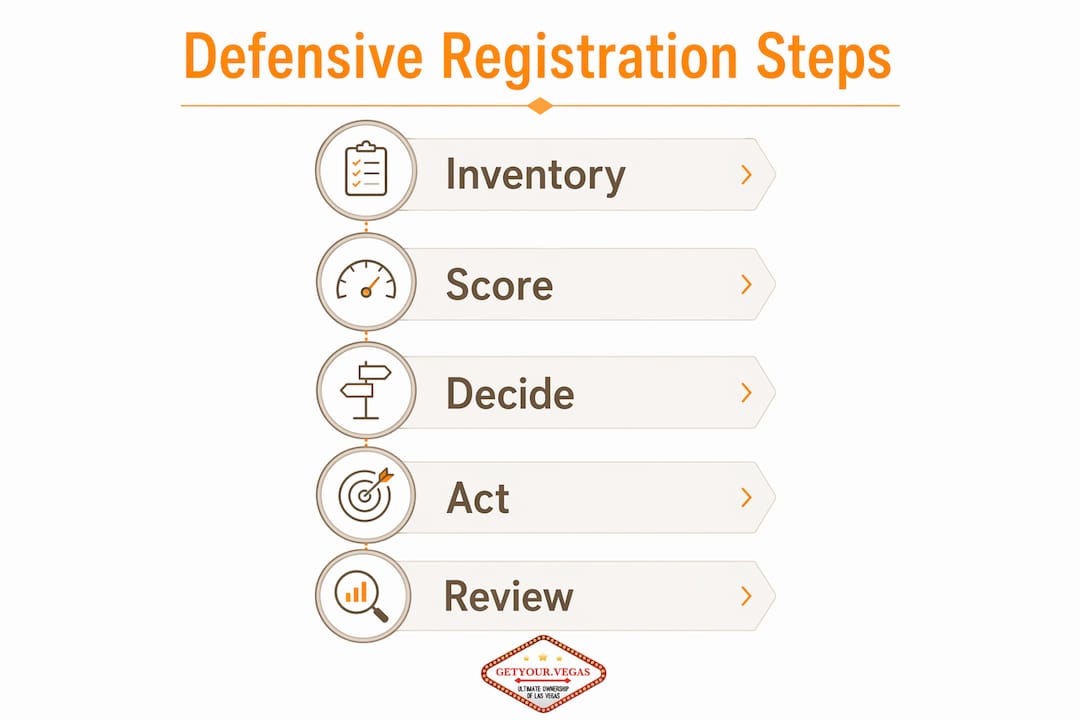
Run this four-step workflow before registering anything:
Step 1: Inventory. List every plausible variant of your .VEGAS name. Include common misspellings, hyphenated versions, and keyword additions like "support," "billing," and "booking."

Step 2: Score each variant. Use the table below.
| Scoring factor | High (3 pts) | Medium (2 pts) | Low (1 pt) |
|---|---|---|---|
| Likelihood of abuse | Easy to misspell, high search volume | Moderate misspelling risk | Hard to misspell, low traffic |
| Impact if abused | Customer transactions, payments | Brand confusion, lost traffic | Minimal customer exposure |
| Customer touchpoint | Appears in ads, invoices, signage | Website only | Internal use only |
Names scoring 7–9 points: register or lease immediately. Scores of 4–6: monitor actively. Scores of 3: skip for now.
Step 3: Decide and act. Buy, lease, or set a monitoring alert based on the score.
Step 4: Record and schedule review. Log every decision with the renewal owner's name and a review date. Revisit the full inventory every 12 months or after any major brand change.
What should you do immediately after acquiring a defensive .VEGAS name?
Lock it down before anything else. Failure to renew is the single biggest risk with defensive assets, so treat them with the same discipline as your primary domain.
- Set the registrant to your legal business entity, not a personal email address.
- Centralize all domain accounts under one registrar login with a shared team credential.
- Enable auto-renewal on every defensive name.
- Add at least one secondary contact for renewal notifications.
- Apply registrar lock (ClientTransferProhibited) immediately after transfer.
- Request a registry-level lock (serverTransferProhibited) for your highest-value names. This requires manual verification with the registry operator and blocks social-engineering attacks that bypass registrar controls.
- Enable two-factor authentication, preferably with a hardware security key, on the registrar account.
For unused defensive names, publish no DNS records that expose infrastructure. A blank or minimal DNS configuration reduces your attack surface. DNSSEC is worth enabling on any name that could realistically be resolved by customers.
Pro Tip: Centralized domain management with auto-renewal and accurate WHOIS contact data prevents the most common failure mode: a defensive asset expiring and getting picked up by the exact threat actor you were blocking.
What do costs and timelines look like for .VEGAS defensive names?
Cost shapes vary significantly by route. Registration fees for newly available names are the lowest entry point. Leases carry recurring fees but spread cost over time, which suits brands managing cash flow. Auction premiums reflect competitive demand and can run substantially higher than direct registration. Brokered offers land somewhere between the two, depending on how motivated the current holder is.
| Acquisition route | Typical timeline to control | Recommended lead time before launch |
|---|---|---|
| Register (new availability) | Same day | 1–2 days |
| Lease (negotiated) | Days to 1–2 weeks | 2 weeks |
| Make an offer (brokered) | 1–4 weeks | 4 weeks |
| Auction | Days to 2 weeks | 2–3 weeks |
| Transfer after purchase | — | 2 weeks |
Renewal reminders should run at 90, 60, 30, and 7 days before expiration. Set all four in your calendar or registrar dashboard the day you acquire a name.
How do you keep your .VEGAS portfolio protected over time?
One-time registration is not enough. Modern brand protection has shifted to continuous, intelligence-driven monitoring that aligns defensive spend with current risk rather than locking in a fixed portfolio forever.
A practical monitoring program covers four areas:
- New domain watch: Automated alerts for newly registered .VEGAS names that match your brand patterns.
- Lookalike detection: Periodic scans for homoglyphs, combosquatting variants, and keyword additions across all TLDs, not just .VEGAS.
- Email-spoof domain checks: Flag any lookalike domain that has an active mail record configured. That's an active threat, not a passive one.
- Scheduled portfolio reviews: Quarterly check that every defensive name is renewed, locked, and still relevant to your current brand.
Assign a named owner for renewal control. When that person changes roles, the handoff must include registrar credentials, renewal dates, and the monitoring feed. Domain monitoring feeds and DMARC reports also preserve evidence for enforcement if you ever need to escalate.
What defensive registration won't fix, and what else you need
Owning a defensive domain does not stop a threat actor from spoofing your email from a completely different domain. DMARC, SPF, and DKIM are the decisive controls for preventing email-based impersonation, and they work independently of how many domains you own. Without them, your brand can be spoofed even if you hold every obvious .VEGAS variant.
DNSSEC and strong account security (hardware keys, centralized access) close the infrastructure gaps that domain ownership alone leaves open.
On the legal side: if a lookalike domain is already registered and actively used for fraud, registration is no longer the answer. That's when you escalate to a UDRP proceeding, a registrar takedown request, or legal counsel under the Lanham Act. Monitoring feeds preserve the evidence you'll need.
Pro Tip: List your legal business entity as the registrant on every domain, defensive or primary. Personal email addresses as registrant contacts create social-engineering risk and complicate ownership disputes.
How WEDDINGS.VEGAS built brand identity with a .VEGAS domain
WEDDINGS.VEGAS is one of the clearest examples of what a well-chosen .VEGAS name does for a brand in this market. The domain communicates the service, the location, and the audience in a single string. No tagline required.
The practical outcomes were direct: marketing messaging became simpler, offline-to-online conversion improved because the domain was memorable enough to type from a business card or billboard, and inbound interest from couples planning Las Vegas weddings increased. The domain did the positioning work that a generic .com with a city modifier never could.
WEDDINGS.VEGAS demonstrates that a .VEGAS domain isn't just a defensive asset. Used actively, it becomes the brand's sharpest marketing tool in a city where location identity is everything.
GET YOUR VEGAS supported the acquisition and ongoing management of WEDDINGS.VEGAS, with leasing and optional billboard advertising available as part of the service package. That combination, a premium domain paired with physical visibility, is a model any Las Vegas brand can replicate.
Key Takeaways
Defensive domain registration for .VEGAS is a risk-management decision: register or lease brand-critical variants, apply registry locks and email authentication, and monitor continuously rather than buying every possible permutation.
| Point | Details |
|---|---|
| Score before you spend | Use likelihood, impact, and customer touchpoint to prioritize which .VEGAS variants need immediate action. |
| Lease or buy brand-critical names | Names tied to customer transactions or paid advertising warrant immediate acquisition, not just monitoring. |
| Registry locks stop hijacking | Apply ClientTransferProhibited at minimum; request a registry-level lock for your highest-value names. |
| DMARC is non-optional | Email authentication closes the spoofing gap that domain ownership alone cannot address. |
| GET YOUR VEGAS | Leasing, auction, and make-an-offer routes are available through GET YOUR VEGAS, in the market since 2009. |
The case for targeted, not blanket, defensive registration
Most businesses waste money on defensive domains they never needed. The real risk isn't failing to register every variant. It's failing to protect the two or three names that a motivated attacker would actually use against your customers. That's a much shorter list than most brand managers assume, and it's entirely manageable with a scored inventory and a monitoring feed.
The .VEGAS extension is an asset, not a liability. A well-run defensive portfolio for a Las Vegas brand might be three to five names, all leased or owned, all locked, all monitored. That's it. The goal is precision, not coverage for its own sake.
Your .VEGAS brand deserves more than a placeholder
GET YOUR VEGAS has been the specialist for .VEGAS domain leasing, sales, and auctions since 2009. If you've identified brand-critical names that need securing, the fastest path is through a platform that knows this TLD from the inside out.

You can browse available lease options for premium .VEGAS names, participate in upcoming auctions, or submit an offer on a specific name you have in mind. GET YOUR VEGAS handles the negotiation, transfer, and ongoing management so you stay focused on your Las Vegas brand, not the paperwork. Ready to secure your name? Start at getyour.vegas.