
A domain lease agreement is a contract where a domain owner (the lessor) grants someone else (the lessee) the right to use a domain name for a fixed term in exchange for scheduled payments, without transferring ownership until any option-to-purchase terms are satisfied. Think of it the same way you think about leasing office space instead of buying the building. You get the use and the branding benefit now, and you avoid tying up capital on a domain that might cost more than most people want to pay in one shot.
This guide gives you three things you can use today: a breakdown of what a downloadable template should include, a clause-by-clause annotated walkthrough of the sections that actually matter, and real pricing examples pulled from contracts filed with the SEC. You'll also get an escrow and transfer checklist, a red-flag list, and a negotiation script.
Here's the direct next step depending on where you're starting:
- Want the paperwork first? Grab the sample structure covered in the DomainSherpa interview with attorney Zak Muscovitch, then adapt it clause by clause using the guide below.
- Already negotiating a deal? Skip to the pricing and escrow sections to sanity-check the numbers you're being offered.
- Handling a high-value domain or bundled assets (website, trademarks, software)? Read the legal next-steps section before you sign anything.
Key Takeaways
A domain lease agreement works when the term, payment schedule, escrow mechanics, and default definitions are all specific and documented in writing before either party sends money or transfers access.
| Point | Details |
|---|---|
| Choose the right format | Pick pure rental, lease-with-option, or lease-to-own based on whether ownership is the actual goal. |
| Insist on escrow | Use a named provider like Escrow.com to hold funds and control the transfer trigger. |
| Define defaults narrowly | Specific default events with a 10 to 15 day cure period protect both lessor and lessee. |
| Document payments in Schedule A | Record the full amortization schedule, not just the monthly total, to avoid payoff disputes. |
| Lease .VEGAS through a managed service | GET YOUR VEGAS handles valuation, drafting, and escrow coordination for .VEGAS domain leases. |
Table of Contents
- Domain Lease Agreement Basics: What It Covers and the Three Common Formats
- What's in the Downloadable Domain Lease Agreement Template
- Annotated Clause-by-Clause Guide to a Domain Lease Contract
- How to Price a Domain Lease and What the Payments Look Like
- Escrow and Registrar Transfer Steps for a Leased Domain
- Red Flags in a Domain Lease Proposal and How to Fix Them
- Negotiation Checklist: Questions to Ask Before You Sign
- When to Bring in an Attorney for a Domain Lease
- A Publisher's Perspective on Leasing .VEGAS Domains
- How GET YOUR VEGAS Handles Leasing for You
- Frequently Asked Questions
- Sources
Domain Lease Agreement Basics: What It Covers and the Three Common Formats
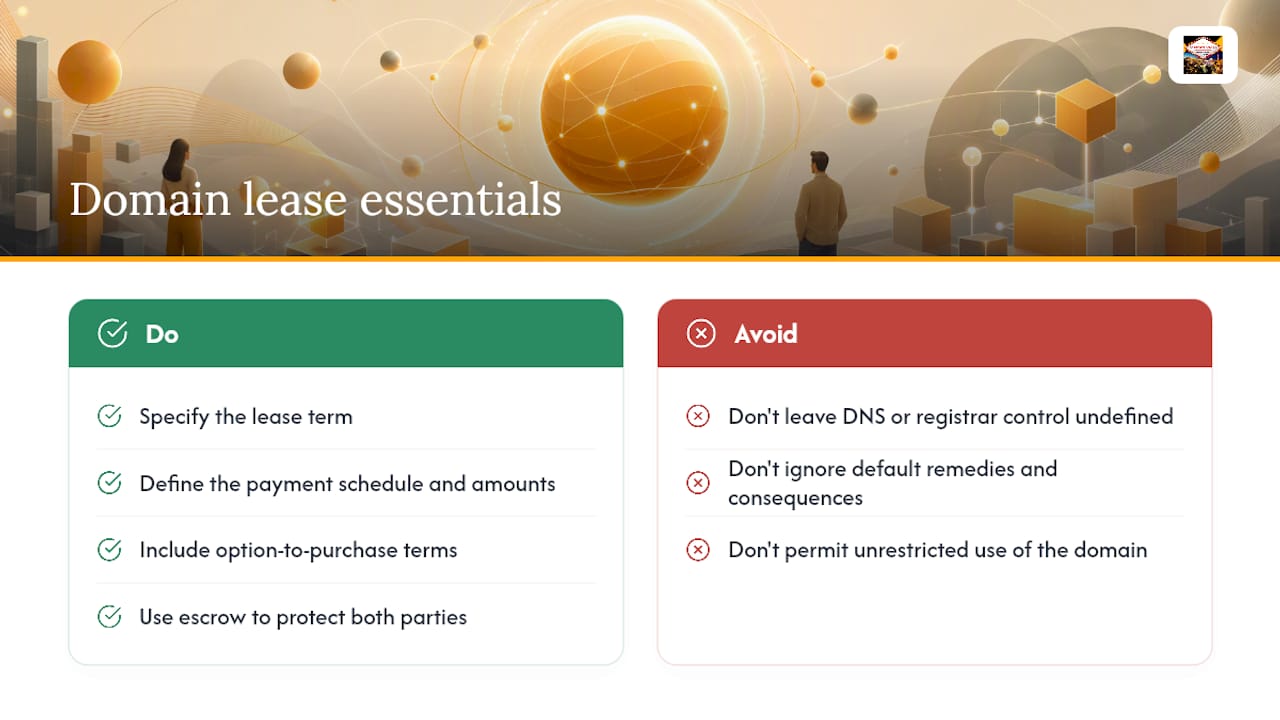
A domain leasing agreement typically covers seven things: the lease term, the payment schedule, whether there's an option to purchase, how escrow protects both parties, who controls DNS and registrar settings during the term, what happens on default, and what the lessee is allowed to do with the domain while they're using it. Miss any one of these and you're negotiating a handshake deal with legal paperwork stapled to it.
Three formats dominate the domain leasing contract world, and picking the wrong one for your situation is the single most common mistake first-time lessees make.
Pure rental is the simplest structure. The lessee pays for the right to use the domain for a set term, usually 12 to 36 months, with no path to ownership baked in. A startup testing whether a premium domain actually moves conversion might pay $2,000 a month for a year before deciding whether to negotiate a purchase separately.
Lease-with-option-to-purchase adds a window during which the lessee can buy the domain outright at a pre-agreed price, often with some or all lease payments credited toward that purchase price.
Lease-to-own (payment plan) amortizes the full purchase price across the lease term, so by the final payment, ownership transfers automatically. This is the structure used in the Domain Capital, LLC lease with Banks.com, Inc., which ran 60 months with fixed monthly payments building toward full title transfer.
The format you choose changes almost every other clause in the contract, which is exactly why the next section starts with the paperwork itself.
What's in the Downloadable Domain Lease Agreement Template
A usable template isn't a single document. It's a package, and if what you've been handed is one page with blanks to fill in, you're missing the pieces that actually protect you during a dispute.
A complete domain lease template should include:
- Master lease agreement with the full clause set (defined terms, grant of rights, payments, default, termination, dispute resolution).
- Schedule A: payment schedule, listing every due date, payment amount, and running balance.
- Payment amortization attachment, showing how each payment splits between rent and any credit toward a purchase option.
- Escrow instructions, naming the escrow provider and defining exactly what triggers a domain transfer or release of funds.
- Sample transfer and bill-of-sale language, ready to execute the moment an option to purchase is exercised.
- Registrar transfer checklist, covering EPP code handling, WHOIS updates, and domain locking during the term.
- Clause index, flagging which sections need jurisdiction-specific edits before you sign.
The most reliable starting point is the sample structure Zak Muscovitch walks through in the DomainSherpa interview on domain leasing, which offers a free example agreement alongside commentary on how each provision should be tailored. The annotated template used at NamesCon Online 2021 goes a step further, adding line-by-line notes explaining why each clause exists and where lessors and lessees typically push back.
Pro Tip: Never use a domain lease template verbatim. Jurisdiction clauses, tax allocation language, and default definitions written for one state's law can create unenforceable terms in another. Strip out anything that references a specific governing law or venue until you've confirmed it matches your actual deal.
Annotated Clause-by-Clause Guide to a Domain Lease Contract
Every domain rental contract lives or dies on a handful of clauses. Get these right and the rest of the document is largely boilerplate.
Definitions. Define "domain," "term," "option price," and "default" precisely. Vague definitions are where disputes start, since a poorly worded default clause gives either party room to argue their way out of an obligation.
Lease grant. State exactly what rights transfer: use of the domain for hosting, DNS control, and any bundled assets. The Domain Capital lease with Banks.com bundled the domain together with the live website, related software, documentation, and trademarks, which is worth copying if your lessee needs to operate a functioning site rather than a bare domain.
Term and commencement. Specify the start date tied to a concrete event, like escrow confirmation of domain lock, not just a calendar date that might precede actual technical transfer.
Payments and security deposit. Spell out the amount, due dates, late fees, and what happens to the deposit if it's applied to cure a default. Contract language should require the deposit to be restored within a set number of days, similar to the Banks.com structure.
Option to purchase. Define the exercise window and price with a specific formula. Example wording: "Lessee may exercise the option by written notice delivered no later than 30 days before the end of the term, accompanied by the option price less any credited payments."
Escrow and transfer mechanics. Name the escrow provider and describe the exact trigger for transfer, whether that's final payment, option exercise, or lease expiration.
Ownership, goodwill, and trademarks. This is where lessees get burned. Any goodwill the lessee builds using the domain during the lease term typically belongs to the lessor unless the purchase option is exercised, according to legal guidance from domain law resources like DNAttorney. If you're building a brand on a leased domain, negotiate this explicitly.
Permitted use and development obligations. Some leases require active development as a material term. The Domain Holdings Inc. lease with FrequentTraveller.com required the lessee to begin developing the domain immediately for the agreed business purpose, with failure to develop treated as a default trigger.
Taxes and fees. Contracts routinely make the lessee responsible for registration fees and applicable taxes, with an obligation to file required returns on the lessor's behalf.
Default and remedies. Narrow, specific default events beat broad language every time. "Failure to pay within 10 days of written notice" is enforceable. "Any breach of this agreement" invites argument.
Termination and cure periods. Give both sides a defined cure window, typically 10 to 30 days, before termination rights kick in.
Right of first refusal and renewals. The FrequentTraveller.com lease included a 15-day right of first refusal if the lessor decided to sell, plus renewal options, both worth requesting if you've invested in developing the domain.
Dispute resolution. Arbitration clauses with a named venue avoid the cost of full litigation over a contract dispute.
| Clause | What Lessors Usually Push For | What Lessees Usually Push For |
|---|---|---|
| Option price | Fixed price set at signing, no credit for rent paid | Rent credited toward purchase price |
| Default definition | Broad language covering "any breach" | Narrow, specific triggers with cure periods |
| Goodwill/trademark | Full assignment to lessor unless option exercised | Carve-out for brand assets built during the term |
| Development obligation | Mandatory active use as a material term | Flexibility on timeline and use case |
| Renewal/ROFR | No automatic renewal, no ROFR | Renewal option plus first-refusal rights |
Pro Tip: If you're the lessee, negotiate the cure period before you negotiate the price. A 30-day cure window on a missed payment is worth more than a $5,000 discount when your business has one bad month.
How to Price a Domain Lease and What the Payments Look Like
Pricing a domain rental contract comes down to four inputs: the domain's underlying valuation, the lessee's cash flow, the term length, and whether an option-to-purchase price is baked into the deal. A domain valued at several hundred thousand dollars might lease for several thousand to more than ten thousand dollars a month depending on how aggressively the lessor wants to amortize toward a sale versus generate ongoing rental income.
Domain lease cost isn't standardized the way apartment rent roughly correlates to square footage. There's no single industry benchmark for term length or payment size, which the DomainSherpa interview with Zak Muscovitch makes explicit. Every deal gets built around what the specific parties can afford and what the domain is actually worth to the lessee's business.
That said, real filed contracts give you usable reference points. The Domain Capital lease with Banks.com structured a 60-month term with monthly payments of $14,274 and a security deposit of $28,547.92, according to the filed contract on Justia. Other SEC-filed domain lease exhibits show similar structures: a payment table with beginning balance, monthly payment, and ending balance columns that function exactly like a mortgage amortization schedule.
Here's a simplified version of what that Schedule A math looks like for a lease-to-own structure on a $600,000 domain over 60 months:
The exact numbers on your deal will differ, but the shape holds: fixed monthly payments chip away at a starting balance until the domain fully transfers. Whoever drafts the lease should specify in Schedule A who covers registrar transfer fees and applicable taxes on each payment, since Banks.com's contract made the lessee responsible for both.
Pro Tip: If you're prepaying early to close out a lease-to-own arrangement, get the payoff math in writing before you send funds. Ask for a written payoff statement showing the exact remaining balance as of the payment date, not an estimate.
Escrow and Registrar Transfer Steps for a Leased Domain
Escrow is not optional for any domain lease agreement above a few thousand dollars in total value. It's the mechanism that keeps either party from walking away with the money or the domain before the other side gets what they're owed.
Here's the operational sequence a well-structured domain leasing agreement should follow:
- Select an escrow provider. Escrow is the standard choice for domain transactions, handling both funds and, in some structures, domain-holding services during the transaction.
- Set up the escrow account with both parties' information and the agreed payment or transfer terms documented in writing.
- Establish the domain hold workflow. Some leases keep the domain registered with the lessor while granting the lessee DNS access; others use escrow-controlled holding until specific milestones are met.
- Trigger the first payment. Funds move into escrow, confirming the lessee's commitment before any technical access changes hands.
- Release DNS control or EPP code, depending on the workflow. A pure rental usually just grants DNS access without an EPP code handoff. A lease-to-own arrangement typically holds the EPP code in escrow until final payment.
- Communicate with the registrar. Confirm domain lock status, verify WHOIS accuracy, and document who the administrative contact is during the lease term.
- Execute final transfer on option exercise or final payment, with escrow releasing the EPP code and the bill of sale simultaneously.
The annotated NamesCon template specifically recommends using a named escrow provider for holding the domain during the lease term rather than relying on informal trust between parties, and outlines standard option-exercise and escrow-triggered transfer language you can adapt.
Two workflows show up most often in practice: escrow-hold with buyer-managed DNS (the lessee runs the site, the lessor's registrar account stays locked) or escrow-controlled transfer on purchase (nothing moves until the final payment clears escrow). Specify which one governs your deal directly in the lease, not just in a side conversation with the escrow agent.
Pro Tip: Keep the domain locked at the registrar for the entire lease term unless a specific milestone in the contract calls for unlocking it. An unlocked domain during an active dispute is an open invitation for someone to move it before the issue gets resolved.
Red Flags in a Domain Lease Proposal and How to Fix Them
Some contract language should stop you before you sign anything, no matter how good the domain itself looks.
Vague default definitions. Language like "any breach of this agreement" without specific triggers gives whoever wants out of the deal an easy exit. Fix it by listing exact default events: missed payment beyond a defined cure period, unauthorized subleasing, or failure to maintain domain lock.
No escrow requirement. If the other party resists using an escrow provider, that's a signal they're planning to control both the money and the asset with no third-party check. Insist on escrow as a non-negotiable term, not a nice-to-have.
Unenforceable goodwill disclaimers. Some lessors try to claim all brand value the lessee builds, even after a purchase option is exercised. Add a specific carve-out that goodwill and trademark rights transfer with ownership once the option is exercised.
Unlimited subleasing rights. A lease that lets the lessee sublease the domain to third parties without lessor approval creates a chain of liability nobody can track. Cap subleasing rights or require written consent.
Missing IP and trademark carve-outs. If the lessee is building a business under the domain name, the contract needs explicit language on what happens to any trademarks registered during the term.
Unclear tax responsibility. Contracts should state plainly who covers registration fees, applicable sales tax, and any required tax filings, following the pattern used in the Banks.com lease.
Short cure periods. A 3 day cure window on a missed payment is designed to trigger default, not to give a good-faith tenant room to fix an oversight. Push for at least 10 to 15 days.
Unconscionable prepayment penalties. Some leases charge a penalty for paying off the balance early, which works against a lessee who wants to exercise a purchase option ahead of schedule. Negotiate prepayment terms that credit early payoff rather than penalize it.
During the lease term itself, build in periodic reporting or performance milestones, especially if the lessee is developing the domain into a real business asset. Precise default definitions and clear termination protocols let a lessor reclaim the domain without a drawn-out dispute, and they protect a lessee's investment in whatever brand equity they've built by the time an option comes due.
Negotiation Checklist: Questions to Ask Before You Sign
Before you put your signature on any domain leasing contract, get straight answers to these questions:
- Who pays registrar transfer fees and any applicable sales or use taxes?
- Is escrow mandatory, and which provider will hold funds and the domain?
- What exactly triggers the purchase option, and is there a formula for calculating the final price?
- How long is the cure period for a missed payment or other default?
- Are any additional assets bundled in, like a website, software, documentation, or trademarks?
- What are the renewal terms, and does the lessee get a right of first refusal if the lessor decides to sell?
- Does subleasing require written consent from the lessor?
- What happens to goodwill and trademark rights built during the term if the option isn't exercised?
Lessors typically prioritize protecting the underlying asset value, locking in predictable payments, and retaining the right to reclaim the domain quickly on default. Lessees typically prioritize a fair path to ownership, protection for any brand equity they build, and cure periods generous enough to survive a rough month.
Escalating rent structures (where monthly payments increase at defined intervals) can create useful incentives for both sides: the lessor gets a rising income stream, and the lessee gets pressure to exercise a purchase option before payments climb too high. Document every negotiated compromise directly in Schedule A rather than leaving it in email threads, since that's what actually gets referenced if a dispute arises later.
When to Bring in an Attorney for a Domain Lease
Legal review stops being optional once you're dealing with a high-value domain, bundled assets like software or trademarks, a cross-border transaction, or any real intellectual property risk tied to the domain's use. A $500 domain rental for a side project probably doesn't need a lawyer. A six-figure lease-to-own arrangement bundling a live website and registered trademarks absolutely does.
When you sit down with counsel, bring the draft lease itself, the domain's registration history, any traffic or monetization data relevant to valuing the deal, and your desired option price and payment schedule. An attorney can spot enforceability problems in default and termination language faster than you can by reading the contract twice.
Cost ranges vary by scope. A straightforward review and markup of an existing template typically runs on the lower end of hourly legal fees, while full transaction support, including escrow coordination and drafting a lease from scratch, costs more and takes longer. Either way, that expense is small compared to the cost of an unenforceable default clause on a six-figure asset.
This article provides general information about domain lease agreements and is not a substitute for professional legal advice. Confirm current contract requirements and enforceability standards in your jurisdiction with a qualified attorney before signing.
A Publisher's Perspective on Leasing .VEGAS Domains
Working inside .VEGAS domain leasing for years teaches you one thing fast: the businesses that succeed with a leased domain are the ones who treat the lease term as a trial run for a real brand commitment, not a cheap placeholder. A local wedding planner or events business leasing a .VEGAS domain isn't just renting a URL. They're testing whether that domain moves the needle on trust and conversion before locking in a purchase.

WEDDINGS.VEGAS is the clearest example of what that trial-to-ownership path looks like in practice. A branded domain built around a specific, high-intent local search term does more for credibility in the Las Vegas market than a generic name ever could, and that's exactly the kind of signal a lease-with-option-to-purchase structure is built to capture: low upfront risk, a clear path to full ownership once the brand proves itself.
The clients who get burned aren't the ones who lease. They're the ones who sign a lease without a defined option price, without escrow, or without a clear cure period. Then, they find out too late that the lessor holds all the leverage. A domain lease agreement done right protects both sides. Done carelessly, it protects neither.
How GET YOUR VEGAS Handles Leasing for You
If everything above sounds like more paperwork than you want to manage yourself, GET YOUR VEGAS runs the leasing process for you on .VEGAS domains, so you skip the drafting, escrow coordination, and registrar back-and-forth entirely.

GET YOUR VEGAS provides full-service support for businesses and individuals leasing a .VEGAS domain, including domain valuation, drafting support tailored to your term and payment structure, escrow coordination through the transfer, and managed handoff once an option to purchase is exercised. You get a domain built for credibility in the Las Vegas market without negotiating every clause alone or guessing at fair pricing.
If you're ready to see what leasing a .VEGAS domain looks like for your business, check out the current lease options or make an offer to start the conversation directly.
Frequently Asked Questions
What is a domain lease agreement? A domain lease agreement is a contract where a domain owner grants another party the right to use a domain name for a fixed term in exchange for scheduled payments, with ownership transferring only if the agreement includes and the lessee exercises a purchase option.
How much does it cost to lease a domain? Domain lease cost varies widely based on the domain's valuation, term length, and whether payments amortize toward a purchase option. Filed contracts show monthly payments ranging from a few hundred dollars for lower-value domains to over $14,000 a month on a six-figure domain under a 60-month lease-to-own structure.
Do I need escrow for a domain rental contract? Yes, for any deal above a few thousand dollars in total value. Escrow protects both the lessor and lessee by holding funds and controlling the domain transfer trigger, rather than relying on trust between two parties who may never meet in person.
What's the difference between leasing and buying a domain outright? Leasing lets you use a domain for a fixed term without the upfront capital a full purchase requires, and many lease structures include an option to convert to ownership later. Buying outright transfers full title immediately but requires the entire purchase price upfront.
Can I use a domain lease template without a lawyer? For lower-value, straightforward rentals, a well-annotated template like the one from DomainSherpa may be sufficient. For high-value domains, bundled assets, or cross-border deals, legal review is worth the cost to confirm your default, termination, and tax clauses are enforceable in your jurisdiction.
Sources
The examples cited throughout this guide are worth reading in full if you're drafting or reviewing your own agreement.
- Example Domain Lease Agreement – and Everything You Need to Know About Domain Name Leasing – with Zak Muscovitch
- Domain Name Lease Agreement between Domain Capital, LLC and | Banks.com, Inc.
- Lease Agreement
- Annotated Domain Name Lease Agreement - v.1 NamesCon Online 2021