
A domain trademark conflict resolves through one of three paths: file an administrative complaint through WIPO's UDRP process, pursue federal litigation under the Anticybersquatting Consumer Protection Act (ACPA), or negotiate a direct settlement. Which path you take depends on what you need and how clear-cut the bad faith is. Before you choose, do these things immediately:
- Preserve evidence now. Take timestamped screenshots of the disputed domain, its content, and any redirects. Archive the WHOIS record before it changes.
- Check registration dates. Pull the domain's creation date and compare it against your trademark's priority date (first use in commerce or federal registration).
- Run parallel searches. Search the USPTO trademark database and a WHOIS lookup simultaneously to map the timeline.
- Lock your own domain. If you control the domain in question, enable the registrar's transfer lock immediately.
- Avoid public statements. Impulsive social media posts or aggressive public demands can complicate negotiations and create evidentiary problems.
The authorities this guide relies on: the USPTO for trademark rights, WIPO and ICANN for the UDRP administrative process, and the ACPA (codified at 15 U.S.C. § 1125) for federal court remedies.
Table of Contents
- What does a domain trademark conflict actually mean?
- What are the most common types of domain–trademark conflicts?
- How does the UDRP process work, and when should you use it?
- When does federal court under the ACPA make more sense?
- What should trademark owners do when they find an infringing domain?
- What if you own the domain and someone is accusing you?
- How can you prevent a domain trademark conflict before it starts?
- How do panels and courts actually decide these cases?
- What are realistic timelines and costs for each path?
- When should you contact an intellectual property attorney?
- Key Takeaways
- The real lesson most brand owners miss
- Useful sources and further reading
What does a domain trademark conflict actually mean?
Registering a domain name does not create trademark rights. Registering a trademark does not automatically give you the right to the corresponding domain. The USPTO is direct on this: a domain name is a technical web address administered through registrars and overseen by ICANN, while a trademark is a source identifier for goods or services, protected through federal registration or common-law use. They are separate legal assets governed by entirely different systems.
The practical consequence is significant. Priority in a trademark dispute depends on your trademark's first-use date or registration date, not when you registered the domain. A business that has used a brand name in commerce since 2018 but only registered the domain in 2022 may still hold stronger trademark rights than someone who grabbed the domain in 2019 with no commercial use behind it.
Where the two systems overlap is in branding. When a domain name is displayed prominently on packaging, advertising, or a website as a brand identifier rather than just a URL, it can function as a source-identifying mark under USPTO guidance. That overlap is exactly where most trademark domain disputes originate.
What are the most common types of domain–trademark conflicts?
Not every conflict is cybersquatting. Classifying your dispute correctly determines which remedy fits.
Cybersquatting is the most recognized form: someone registers a domain that matches or closely mimics your trademark with the intent to profit, usually by selling it back to you or diverting your customers. Red flags include registration shortly after your trademark filing, a parked page with pay-per-click ads, or an immediate offer to sell.
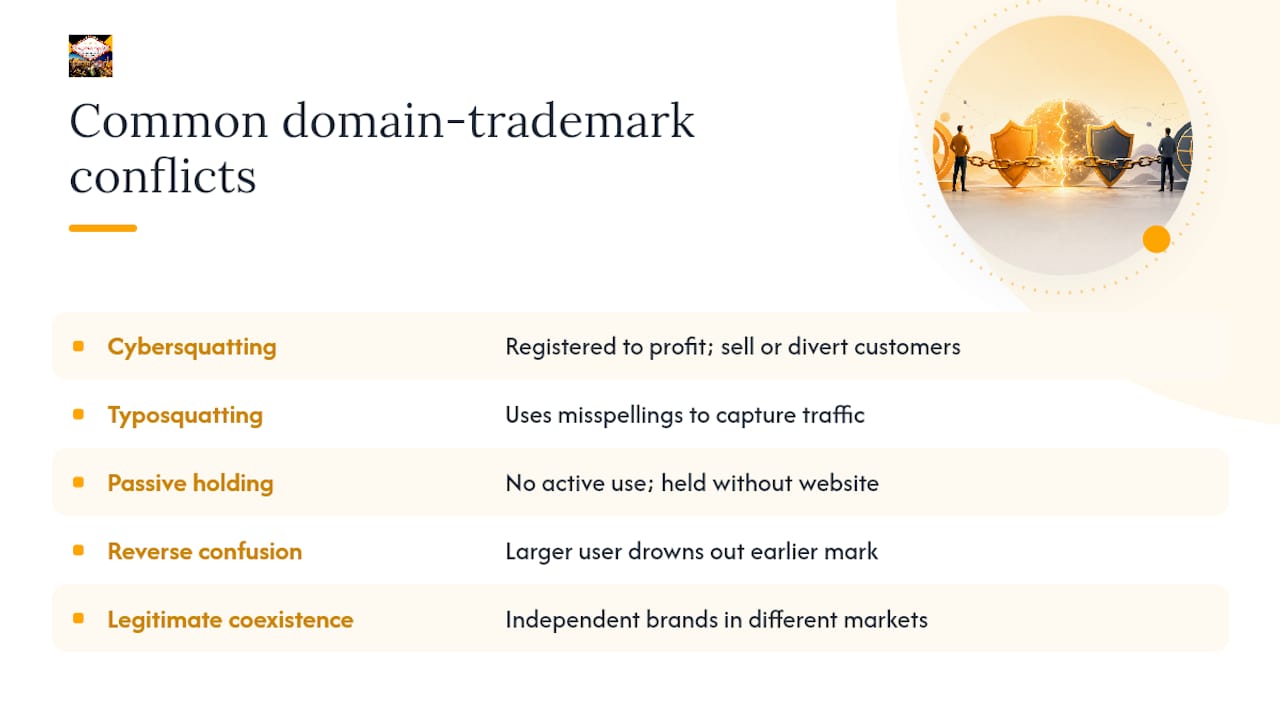
Typosquatting targets predictable spelling errors. Think "Amaz0n.com" or "Chewwy.com." The goal is the same: capture traffic meant for you. A WIPO panel decision in Case No. D2024-2975 involving Chewy, Inc. illustrates how panels treat these: even small additions or letter substitutions do not save a registrant when the trademark is clearly reproduced and the gTLD (.com, .net) is disregarded in the similarity analysis.
Passive holding is subtler. The registrant holds a domain that matches your mark but does nothing with it — no website, no active use. Panels still find bad faith here when the mark is well-known and there is no plausible legitimate use.
Reverse confusion flips the script: a larger company starts using a domain or brand that resembles a smaller, earlier user's mark, drowning out the original. This one rarely fits UDRP because the larger party usually has legitimate rights — federal court is the more appropriate venue.
Legitimate-but-confusing coexistence happens when two parties independently develop similar brands in different markets. These cases are genuinely complex and often land in negotiation or litigation rather than UDRP.
Pro Tip: Check the domain's registration history using a WHOIS history tool like DomainTools before assuming bad faith. A domain registered years before your trademark's priority date signals a legitimate-use defense, not cybersquatting.
How does the UDRP process work, and when should you use it?
WIPO's UDRP is the fastest and most cost-effective route for clear-cut cybersquatting cases. To win, a complainant must prove all three elements:
- The domain name is identical or confusingly similar to a trademark in which the complainant has rights.
- The registrant has no rights or legitimate interests in the domain name.
- The domain name was registered and is being used in bad faith.
All three must be satisfied. Failing even one means the complaint fails.
The UDRP process, step by step:
- Confirm the domain is a gTLD (.com, .net, .org, .info, and others) — UDRP applies to these; ccTLDs like .us have separate policies.
- Select an ICANN-accredited dispute resolution provider (WIPO is the most widely used).
- Prepare and file the complaint with all supporting evidence: trademark registration certificates, WHOIS records, screenshots of the domain's content, and any communications with the registrant.
- The registrar locks the domain upon notification, preventing transfer during the proceeding.
- The respondent has 20 days to file a response.
- A panel (one or three panelists) reviews submissions and issues a decision, typically within 14 days of appointment.
- If the complainant wins, the registrar transfers or cancels the domain within 10 business days unless the respondent files a court action to stay the decision.
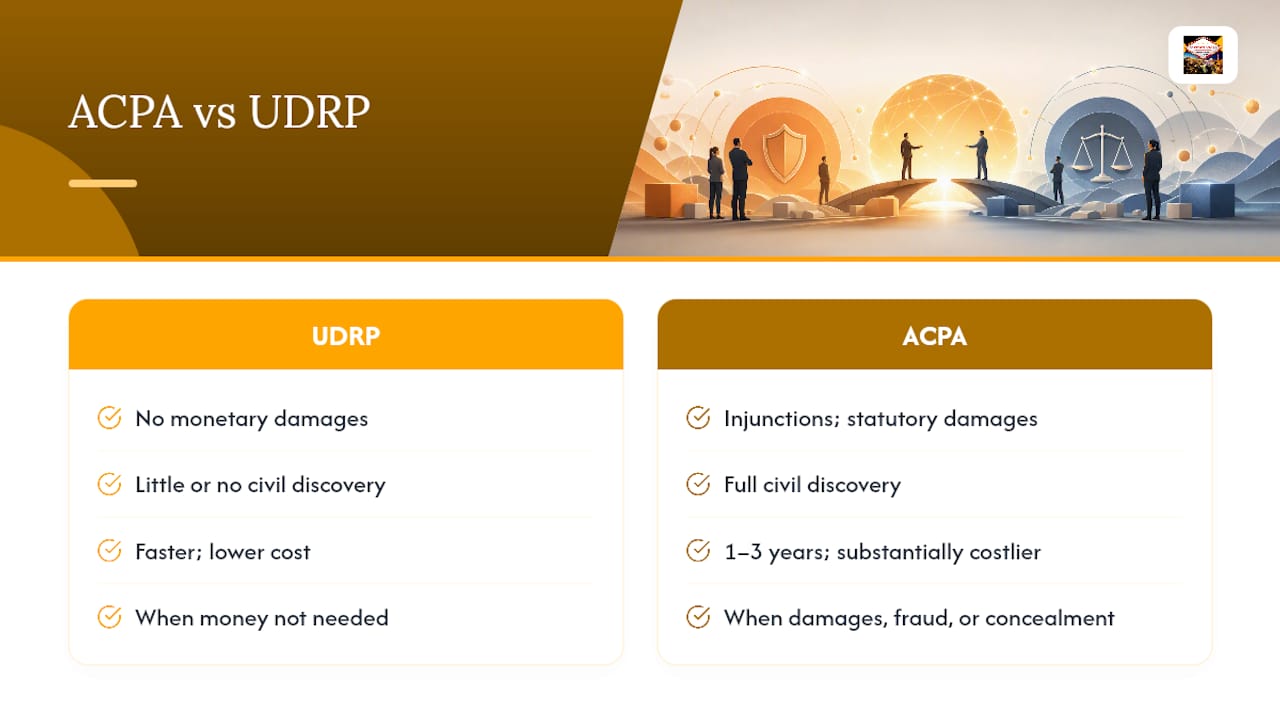
UDRP vs. ACPA at a glance:
| Factor | UDRP | ACPA (Federal Court) |
|---|---|---|
| Venue | WIPO or other ICANN-accredited provider | U.S. federal district court |
| Timeline | Roughly 2–3 months | Often 1–3 years |
| Typical cost | Lower (filing fees plus counsel) | Significantly higher (litigation costs) |
| Remedies | Transfer or cancellation of domain only | Injunction, statutory damages, attorney's fees |
| Monetary damages | Not available | Available under 15 U.S.C. § 1125 |
| Discovery | None | Full civil discovery |
| Best for | Clear bad-faith cybersquatting | Complex disputes, damages needed |
Knobbe Martens practitioners note that UDRP works well for clear cybersquatting but often fails in complex business disputes, broken business relationships, or cases where discovery is needed to establish the facts.
When does federal court under the ACPA make more sense?
Use the ACPA when you need something UDRP cannot give you: money.
"When administrative remedies fail or are insufficient, trademark owners may pursue federal litigation under the Anticybersquatting Consumer Protection Act to obtain damages and other relief unavailable through UDRP." — Hornwright IP Law
The ACPA, codified at 15 U.S.C. § 1125(d), gives federal courts authority to award injunctions, statutory damages per domain name within a range established by law, and in exceptional cases, attorney's fees. To prevail, a plaintiff must show the defendant had a bad-faith intent to profit from a distinctive or famous mark and registered, trafficked in, or used a domain name that is identical or confusingly similar to that mark.
Federal litigation also opens full civil discovery, which matters when the registrant's identity is concealed, when there are multiple related domains, or when the scheme involves organized fraud. The tradeoff is time and expense. ACPA cases routinely take one to three years and cost substantially more than a UDRP proceeding. That investment makes sense when the infringement has caused real, quantifiable harm — lost sales, customer confusion, reputational damage — or when the registrant is operating a phishing or fraud scheme that requires court-ordered injunctive relief to shut down quickly.
What should trademark owners do when they find an infringing domain?
Speed matters. Here is the priority order:
- Capture and preserve evidence. Take timestamped screenshots of the domain's landing page, any linked pages, and the WHOIS record. Use the Wayback Machine to archive the page immediately.
- Document your trademark's priority date. Pull your USPTO registration certificate or, for common-law marks, gather the earliest evidence of use in commerce (invoices, advertising, dated website captures).
- Check the registrant's identity. Note whether WHOIS privacy is enabled — concealment of identity is itself a bad-faith indicator under UDRP panel reasoning.
- Assess UDRP viability. Does your mark predate the domain registration? Is there evidence of bad faith (parked ads, impersonation, phishing)? If yes to both, UDRP is likely your fastest path.
- Draft a demand letter carefully. A cease-and-desist can open settlement negotiations, but a poorly worded one can tip off the registrant to delete evidence or transfer the domain. Keep it factual, reference your trademark rights, and set a clear response deadline.
- File UDRP or prepare for litigation. If the demand letter produces no response or a bad-faith counter, file the UDRP complaint with all evidence attached. If damages are needed or the case is complex, consult IP counsel about ACPA litigation.
Evidence checklist before filing:
- Trademark registration certificate or proof of first use in commerce
- Domain WHOIS record (current and historical)
- Screenshots of the domain's website content, ads, and any redirects
- Archive.org captures showing the domain's use over time
- Copies of any emails received from the registrant or from confused customers
- Records of any sales pages, phishing attempts, or impersonation content
- Server logs showing traffic diversion (if accessible)
Pro Tip: Coordinate with your IT team before sending any demand letter. Have them capture server logs showing traffic anomalies or redirect patterns — this evidence disappears quickly and can be decisive in both UDRP and ACPA proceedings. Nixon Peabody practitioners emphasize that UDRP allows only one submission round, so all evidence must be ready before you file.
What if you own the domain and someone is accusing you?
Stop. Document everything. Do not delete content, change your WHOIS registration, or transfer the domain until you have legal advice. Any of those moves can look like evidence destruction and will hurt your defense.
Your strongest defenses under UDRP are:
Prior rights or registration. If you registered the domain before the complainant's trademark priority date, document that timeline thoroughly. Pull your registrar's confirmation email, your earliest invoices or business records tied to the domain, and any dated web captures.
Bona fide offering of goods or services. If you were using the domain for a legitimate business before any notice of the dispute, that use is a recognized defense. Gather contracts, customer communications, and dated marketing materials that show genuine commercial activity.
Legitimate noncommercial or fair use. Fan sites, criticism sites, and commentary pages can qualify, provided you are not misleading visitors about your relationship to the trademark owner and not using the domain commercially.
License or consent. If the trademark owner ever authorized your use, find that documentation immediately.
What to avoid: making aggressive public statements about the dispute, posting inflammatory content on the domain, or attempting to sell the domain after receiving a complaint. Each of those actions hands the complainant additional bad-faith evidence. Retain IP counsel, prepare a factual UDRP response with all supporting exhibits, and let the process work. Knobbe Martens practitioners note that UDRP panels decline cases where legitimate competing rights exist — a well-documented defense can and does win.
Pro Tip: If rebranding is a realistic option, explore it early. A voluntary rebrand before a UDRP decision preserves goodwill, avoids a public loss on the record, and often leads to a negotiated settlement that costs less than a full proceeding.
How can you prevent a domain trademark conflict before it starts?
Prevention costs a fraction of enforcement. The single most effective step is running trademark and domain availability searches together before you launch any brand.
- Comprehensive trademark search. Use the USPTO's TESS database and consider a professional clearance search covering common-law uses, state registrations, and international marks if you operate across borders.
- Federal trademark registration. Registration gives you a priority date, nationwide constructive notice, and the legal presumption of ownership — all of which strengthen any future UDRP complaint.
- Defensive domain registrations. Secure your brand name across the key gTLDs (.com, .net, .org) and the ccTLD for your primary market (.us for U.S. brands). For Las Vegas businesses, a .VEGAS domain is worth securing as part of your defensive portfolio — it signals local authority and closes off a natural impersonation vector. GET YOUR VEGAS offers domain leasing options that make defensive registration accessible without a large upfront purchase.
- Consistent branding across channels. Use your domain as a brand identifier, not just an address. Prominent, consistent use builds common-law rights and strengthens trademark claims.
- Ongoing monitoring. Set up domain-watch alerts through your registrar or a monitoring service. Periodic clearance searches every 12–18 months catch new conflicting registrations before they become entrenched problems.
Pro Tip: For U.S.-market brands, prioritize defensive registration in .com, .net, .org, and your industry-specific extension (e.g., .vegas for Las Vegas businesses). Leasing a specialty domain through GET YOUR VEGAS is often faster and more cost-effective than purchasing outright, especially for brands testing a new market. See the defensive domain registration guide for a full checklist.
How do panels and courts actually decide these cases?
Panels focus on the three UDRP elements, but the factual patterns that drive decisions are more specific than the test suggests.
Confusing similarity is assessed by comparing the domain to the mark, ignoring the gTLD. Adding hyphens, extra letters, or generic words rarely saves a registrant. In Case No. D2024-2975 (Chewy, Inc. v. Alexandr Anton), the panel found confusing similarity despite minor variations and ordered transfer, noting that reproducing the core trademark in the domain is sufficient.
Bad faith is where most contested cases turn. WIPO Decision D2025-0808 illustrates the key indicators panels treat as strong evidence: the complainant's mark was distinctive and well-known at the time of registration, the registrant had no plausible legitimate use, and the domain was used to impersonate or mislead consumers.
| Indicator | Panel treatment |
|---|---|
| Domain registered after trademark's priority date | Strong bad-faith signal |
| WHOIS privacy / concealed registrant identity | Supports bad-faith finding |
| Pay-per-click ads targeting complainant's customers | Strong bad-faith signal |
| Passive holding of a well-known mark | Bad faith even without active use |
| Impersonation or copied site content | Near-conclusive bad faith |
| Domain registered before trademark's priority date | Supports legitimate-interest defense |
| Documented bona fide business use | Supports legitimate-interest defense |
| Noncommercial criticism or commentary | May qualify as fair use |
Panels also weigh the registrant's knowledge of the mark at the time of registration. For well-known brands, panels presume knowledge. For less-known marks, the complainant must show the registrant likely knew of the mark through geographic proximity, industry overlap, or direct communications.
What are realistic timelines and costs for each path?
UDRP:
- Filing to decision: roughly 2–3 months for a single-member panel; slightly longer for a three-member panel.
- Filing fees: set by the dispute resolution provider (WIPO's fee schedule is published on its site and varies by number of domains and panelists).
- Counsel fees: variable, but typically lower than litigation; many IP firms handle straightforward UDRP matters on a flat-fee basis.
- Key constraint: Nixon Peabody practitioners emphasize that UDRP has only a complaint and a response phase — no supplemental submissions without panel permission. Every piece of evidence must be ready before you file.
ACPA federal litigation:
- Timeline: typically several years from filing to resolution, depending on complexity and whether the case goes to trial.
- Costs: substantially higher than UDRP, driven by discovery, motion practice, and potential trial preparation.
- Remedies available: injunctions, statutory damages of $1,000–$100,000 per domain, and attorney's fees in exceptional cases under 15 U.S.C. § 1125(d).
Negotiated settlement / ADR:
- Timeline: days to weeks if both parties engage in good faith.
- Costs: typically the lowest of the three paths, especially when counsel facilitates rather than litigates.
- Best for: ambiguous facts, legitimate competing rights, or situations where a business relationship is worth preserving.
Evidence to collect before any proceeding:
- Current and historical WHOIS records
- Timestamped screenshots of the domain and all linked pages
- Archive.org captures showing the domain's history
- Trademark registration certificate or earliest proof of use
- Server logs showing traffic diversion or redirect patterns
- Copies of customer confusion emails or complaints
- Any communications from or with the registrant
When should you contact an intellectual property attorney?
Some situations call for immediate counsel. Do not wait if:
- You need monetary damages — UDRP cannot award them, and ACPA litigation requires an attorney to navigate federal court procedure.
- The dispute crosses borders, involves multiple domains, or shows signs of organized fraud.
- The registrant's identity is concealed and you need subpoena power to unmask them.
- Ownership of the trademark itself is disputed or the chain of title is complicated.
- You have received a UDRP complaint and the deadline to respond is approaching.
When you contact an IP attorney, bring: your trademark registration certificate (or evidence of first use), the domain's WHOIS record, screenshots of the infringing site, and any correspondence with the registrant. Ask specifically about the attorney's UDRP filing experience, their familiarity with ACPA litigation, and whether they offer flat-fee or capped-fee arrangements for domain disputes. A short merits assessment before committing to full litigation is standard practice and worth requesting.
Key Takeaways
A domain trademark conflict resolves fastest when you preserve evidence immediately, identify the conflict type accurately, and match the remedy to what you actually need.
| Point | Details |
|---|---|
| Domain ≠ trademark | Registering a domain creates no trademark rights; priority depends on trademark use or registration date. |
| UDRP three-element test | Prove confusing similarity, no legitimate interest, and bad-faith registration and use to win a UDRP transfer. |
| UDRP vs. ACPA | UDRP is faster and cheaper but cannot award damages; ACPA litigation can, but takes years and costs more. |
| Evidence before filing | UDRP allows only one submission round — collect all screenshots, WHOIS records, and server logs before you file. |
| Prevention beats enforcement | Run trademark and domain searches together before launch; defensive registration closes off the most common attack vectors. |
The real lesson most brand owners miss
Most domain trademark disputes I see could have been avoided with two hours of work at launch: a USPTO trademark search and a defensive domain registration across the obvious extensions. Instead, businesses build brand equity for years, then discover someone has been sitting on their .com variant the whole time, waiting.
The UDRP process is genuinely useful for clear cybersquatting. But here is what the guides rarely say: panels are skeptical of complaints where the complainant's own trademark registration came after the domain was registered. That sequence, even when the complainant has prior common-law rights, creates a harder case. The lesson is to register your trademark early, not after you have already built the brand.
For Las Vegas businesses specifically, the .VEGAS extension is an underused defensive asset. A brand that secures BRAND.VEGAS alongside its .com is harder to impersonate in the local market and signals genuine geographic authority. GET YOUR VEGAS has worked with clients like WEDDINGS.VEGAS who built their entire brand identity around the extension — and that kind of consistent, prominent use builds common-law trademark rights alongside the domain itself. That combination is the strongest position you can hold before any dispute arises.
Useful sources and further reading
- Domain Name Disputes | WIPO
- United States Patent and Trademark Office (USPTO)
- ADMINISTRATIVE PANEL DECISION Chewy, Inc. v. Alexandr Anton Case No. D2024-2975 | WIPO
- 15 U.S.C. § 1125 (Lanham Act provisions) | Legal Information Institute, Cornell Law School
This article provides general legal information, not legal advice. Laws and procedures change; confirm current rules with the USPTO, WIPO, or a qualified intellectual property attorney before taking action.