
An exact match domain (EMD) is a domain name that mirrors a target search phrase word-for-word — think buyusedcars.com or besthikingshoes.com. In 2026, EMDs are a tactical tool that can deliver indirect SEO advantages, not an automatic ranking boost. Google Search Central's ranking systems guide makes this clear: domain name matching is one signal within a broad, multi-factor system, not a standalone shortcut. The Google Exact Match Domain update on September 27, 2012 ended the era when a keyword-stuffed URL alone could push a thin site to page one. What remains is real but conditional: an EMD can lift click-through rates, compress topical relevance signals, and drive type-in traffic — provided the content and authority behind it are genuine.
Key Takeaways
Exact match domains deliver indirect SEO benefits through CTR lift and topical compression, but content quality, authority, and brand signals determine whether those benefits translate into rankings.
| Point | Details |
|---|---|
| EMDs are not ranking shortcuts | Google's 2012 update ended automatic EMD boosts; content and authority drive outcomes. |
| CTR lift is the clearest benefit | A URL matching the search query can increase click-through rates, especially for transactional queries. |
| Topical compression helps new sites | EMDs reinforce relevance signals across anchors and internal links, accelerating topical classification. |
| Brand lock-in is a real cost | Keyword domains limit expansion; weigh trademark risk and growth plans before buying. |
| Brand-led strategy wins long-term | Use a brandable primary domain; deploy EMDs or PMDs tactically for specific high-intent use cases. |
Table of Contents
- What are exact match domains, partial match domains, and branded domains?
- How Google's 2012 EMD update changed everything
- Do exact match domains still help SEO in 2026?
- Pros and cons of using an exact match domain
- How to decide: EMD, brandable, or hybrid?
- Best practices if you build on an exact match domain
- How a .VEGAS domain builds local brand recognition and converts type-in traffic
- How EMDs affect click-through rates and user behavior
- EMDs vs. partial match domains vs. branded domains in SEO
- Successful and unsuccessful modern EMD case studies
- Keyword research aligned with an EMD strategy
- How EMDs interact with Bing, Yahoo, and other search engines
- The domain decision nobody talks about honestly
- Sources
What are exact match domains, partial match domains, and branded domains?
Domain naming falls into three broad categories, and knowing the difference shapes every acquisition decision you make.
Exact match domains contain the full target keyword phrase with no additions. Partial match domains (PMDs) blend a keyword with a brand word or modifier — something like BestHikingGear.com or VegasWeddingPlanner.com. Brandable or hybrid domains drop keyword targeting entirely in favor of a memorable, ownable name — think Airbnb, Zappos, or Weddings.Vegas.
Classic EMD examples you'll recognize:
- hotels.com — the textbook EMD; ranks for hotel-related queries and benefits from massive type-in traffic and brand equity built over decades.
- food.com — exact match for one of the broadest consumer queries online; survives on content volume and authority, not the domain alone.
- buyusedcars.com — high commercial intent baked into the URL; works for lead generation in a competitive vertical.
- besthikingshoes.com — affiliate-style EMD targeting a specific product category query; common in content and review sites.
- cheapflightsbooking.com — stacks two high-intent modifiers; the kind of domain that can look spammy to users even before they click.
Two technical notes worth keeping front of mind. First, .com remains the preferred TLD for EMDs because users default to it, and type-in traffic is a real, measurable benefit. Second, hyphens in domain names — cheap-flights-booking.com, for example — consistently read as lower quality to users and can trigger spam associations. The SEO impact of hyphens in domains is well-documented: avoid them unless there is no clean alternative.
How Google's 2012 EMD update changed everything
Before September 2012, owning the right keyword domain was a genuine shortcut. A site with thin or duplicate content could rank on page one simply because its URL matched the query. Google's engineers recognized this as a manipulation vector and moved to close it.
| Date | Event | Effect |
|---|---|---|
| Pre-2012 | EMDs receive implicit ranking boost | Thin, low-quality sites rank on domain name alone |
| September 27, 2012 | Google EMD update launches | Low-quality EMD sites lose rankings; quality sites largely unaffected |
| — | Panda updates roll out | Content quality becomes a primary ranking signal across all domains |
| — | Core updates and Helpful Content system | E-E-A-T signals, content depth, and authority determine outcomes |
Search Engine Journal's analysis of the EMD update confirms the target was narrow: sites that paired a keyword domain with genuinely useful content saw little disruption. The casualties were sites that treated the domain as a substitute for substance. Google's ranking systems documentation frames this consistently — ranking is a layered system where content quality and overall site signals carry far more weight than any single URL attribute.
Do exact match domains still help SEO in 2026?
The direct answer: EMDs are not a direct ranking signal, but they produce real indirect advantages when backed by quality content and genuine authority.
Clickrank puts it plainly: EMDs are no longer a magic ranking shortcut, but they can deliver higher CTR and perceived relevance when paired with strong content. That CTR lift is the most consistent benefit practitioners report. A URL that contains the exact phrase a user searched tends to look more relevant in the SERP, which can push click rates up even when ranking position stays the same.
The second mechanism is what practitioners call topical compression. When your domain contains the core keyword, every internal link, every external backlink anchor, and every brand mention reinforces the same topical signal. For a new or narrowly focused site, that compression can accelerate relevance classification. It doesn't replace links or content quality — it amplifies them.
Where EMDs hurt rather than help:
- Thin content paired with a keyword domain still triggers quality filters, just as it did post-2012.
- Trademark conflicts are a serious legal risk if your chosen keyword phrase overlaps with a registered brand name.
- Perceived spamminess is real. Users have been trained by years of low-quality EMD spam to distrust URLs that look like keyword strings. cheapflightsbooking.com reads as less trustworthy than, say, Scott’s Cheap Flights.
- Brand lock-in limits growth. A domain built around one keyword phrase makes pivoting the business model or expanding the product line awkward and expensive.
Search Engine Land's 2025-era guidance recommends treating domain choice as a brand identity decision first and a keyword targeting decision second. That framing reflects where search has moved: Google's systems reward entities and brands, not keyword strings.
Pros and cons of using an exact match domain
Pros:
- Type-in traffic from users who guess the URL based on their search intent
- Instant topical relevance signal for tightly focused, single-purpose sites
- CTR lift in SERPs when the URL mirrors the query
- Anchor text consistency across backlinks reinforces topical signals
- Works well for local service businesses targeting a specific geographic query
Cons:
- Brand lock-in makes expansion difficult without a domain migration
- Trademark risk if the keyword phrase is owned or contested by another company
- Perceived low quality — keyword-string URLs can look spammy before users even visit
- Hyphenated EMDs compound the spam perception problem
- Premium EMD prices at auction can far exceed the SEO value they deliver
- Narrow topical scope limits the content strategy you can build
Red flags to avoid: buying a premium EMD at auction without a trademark clearance search; building thin affiliate pages on a keyword domain and expecting the URL to carry rankings; using exact-match anchor text aggressively in an outreach campaign tied to an EMD (over-optimization risk is higher when the domain already signals the keyword).
On cross-engine behavior: Bing has historically shown slightly more sensitivity to keyword-matching domains than Google, but its 2024 and 2025 quality updates have moved it closer to Google's content-first stance. Yahoo's results are powered by Bing, so the same logic applies there.
How to decide: EMD, brandable, or hybrid?
Use this checklist before committing to any domain type:
- Business goal: Is this a single-purpose lead-gen or affiliate site, or a long-term brand?
- Geographic scope: Local service area or national/global?
- Expansion plans: Will you add products, services, or verticals in the next three years?
- Budget: Can you afford a premium EMD, or does a brandable name free up capital for content?
- Trademark risk: Has a lawyer cleared the phrase for your category?
- Project lifetime: Short campaign or permanent brand asset?
| Use case | Best domain type | Why |
|---|---|---|
| Local service business (plumber, event venue) | Partial match or geo-branded | Balances keyword relevance with brand trust |
| Affiliate or content review site | EMD or partial match | High-intent queries, single topic, CTR matters |
| Single-purpose tool or app | Brandable or hybrid | Needs to scale and attract press coverage |
| Long-term consumer brand | Brandable | Brand equity compounds; keyword domains don't |
NameMesh's guidance on brandable vs. keyword domains reinforces this: keyword domains work for local and single-purpose use cases but create friction when the business needs to grow beyond its original category. A partial match name — one that includes a keyword but also carries a brand element — often delivers the best of both. You get topical relevance without the brand ceiling.
Pro Tip: Before buying a premium EMD, run a quick domain negotiation check to confirm the asking price reflects actual traffic and revenue data, not just keyword vanity.
Best practices if you build on an exact match domain
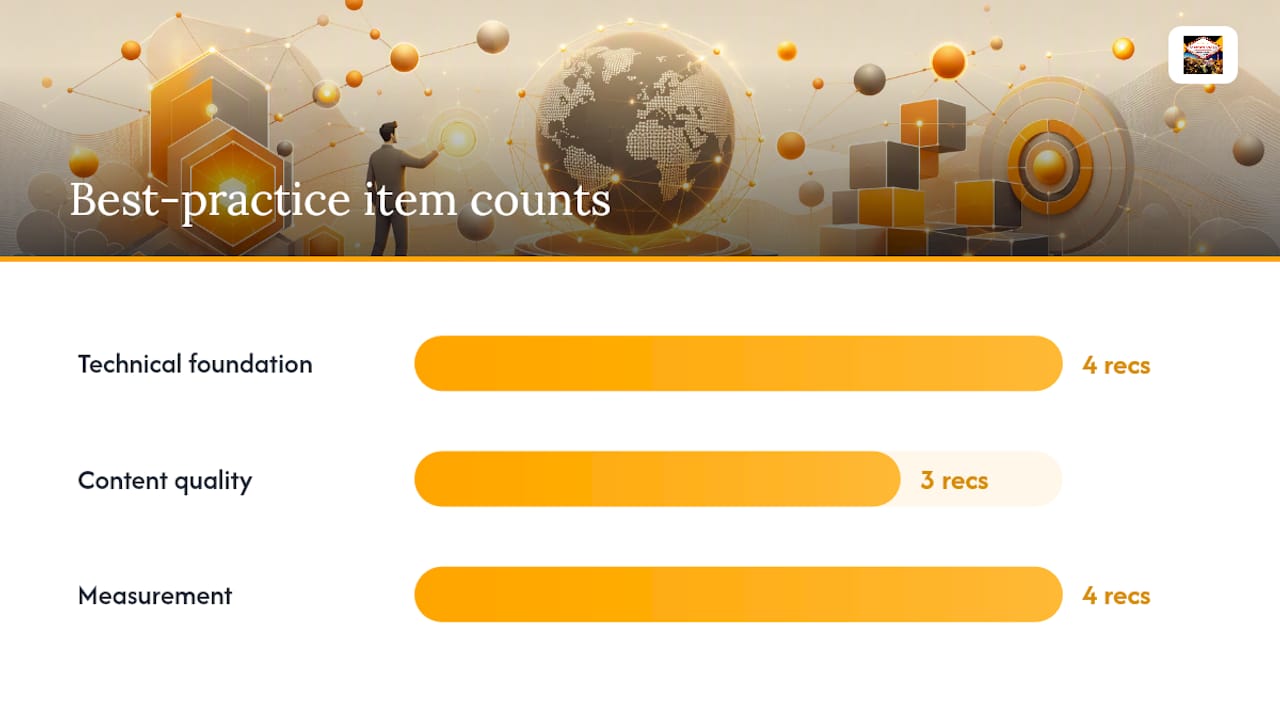
Getting value from an EMD in 2026 requires discipline across three areas.
Technical foundation:
- Set a canonical URL structure and stick to it (www vs. non-www, trailing slash or not)
- Configure proper 301 redirects if you migrate from or to an EMD
- Submit an accurate XML sitemap and use structured data to reinforce topical signals
- Never build doorway pages — thin, keyword-stuffed landing pages that exist only to capture query traffic
Content quality:
- Cover the topic comprehensively. An EMD for "best hiking shoes" needs to be the definitive resource on hiking footwear, not a thin affiliate page with ten product cards.
- Build author and E-E-A-T signals: named authors, credentials, original research or testing, and transparent editorial standards
- Use internal linking to build topical clusters around the core keyword, reinforcing the topical compression the domain already signals
Measurement:
- Track CTR by page in Google Search Console — the clearest signal of whether the EMD URL is lifting click rates
- Monitor branded search volume growth over time; a healthy EMD eventually generates brand queries, not just keyword queries
- Watch engagement metrics (time on page, scroll depth, return visits) to confirm content quality is matching the domain's topical promise
- Track organic keyword diversity; if rankings are concentrated on one phrase, the site is fragile
Pro Tip: Run a simple A/B test by comparing CTR on pages hosted on your EMD against equivalent pages on a branded domain. The delta tells you exactly how much the URL itself is contributing.
How a .VEGAS domain builds local brand recognition and converts type-in traffic
The classic EMD playbook assumes .com and a generic keyword phrase. But local TLDs like .VEGAS offer a different kind of topical compression — one that combines geographic relevance with brand memorability in a way a generic EMD can't replicate.
Consider how WEDDINGS.VEGAS operates. The domain communicates category (weddings) and location (Las Vegas) in two words. A user searching for Las Vegas wedding venues who types weddings.vegas directly into a browser is already past the awareness stage — they're ready to act. That type-in behavior is high-intent traffic that costs nothing per click.
The practical playbook for a .VEGAS domain strategy:
- Landing page structure: Build a single, authoritative page for the core service (weddings, events, dining) that answers the most common queries with real depth — pricing, availability, photos, and reviews.
- Offline cross-promotion: A .VEGAS domain on a billboard, business card, or event flyer is instantly memorable and location-specific. The vanity URL campaign model works precisely because the domain doubles as a call to action.
- Content clusters: Build supporting pages around related queries (chapel options, elopement packages, catering) that link back to the core landing page, reinforcing topical authority.
- Billboard synergy: Las Vegas businesses that pair a .VEGAS domain with physical advertising report direct type-in traffic spikes tied to campaign timing — a measurable offline-to-online conversion loop.
For wedding and event-based businesses, the .VEGAS TLD functions as a partial match domain with built-in geographic authority. It's a modern answer to the EMD question: instead of chasing a generic keyword URL, you own a location-branded asset that compounds in value as your brand grows.
How EMDs affect click-through rates and user behavior
CTR is where EMDs still deliver the most consistent, measurable value. When a SERP result's URL contains the exact phrase a user searched, it creates a visual confirmation that the page is directly relevant. That confirmation nudges users to click, even when the page's title tag or meta description is similar to competitors.
The effect is strongest for high-intent, transactional queries. A user searching "buy used cars online" who sees buyusedcars.com in the results gets an immediate relevance signal from the URL alone. For informational queries, the effect is smaller — users are more likely to evaluate the title and snippet than the domain.
User trust is the limiting factor. Keyword-string domains that look machine-generated — especially those with hyphens or multiple stacked modifiers — can actually suppress CTR because users associate that URL pattern with spam or low-quality affiliate sites. The CTR lift from an EMD is real, but it's conditional on the domain looking credible, not just relevant.
EMDs vs. partial match domains vs. branded domains in SEO
Each domain type produces a different SEO profile, and the differences compound over time.
An EMD concentrates topical signals but limits brand equity. Every backlink anchor that uses the domain name reinforces the keyword, which helps relevance but creates over-optimization risk if the anchor profile becomes too uniform. EMDs also tend to attract links from lower-authority sources because they look like niche or affiliate sites.
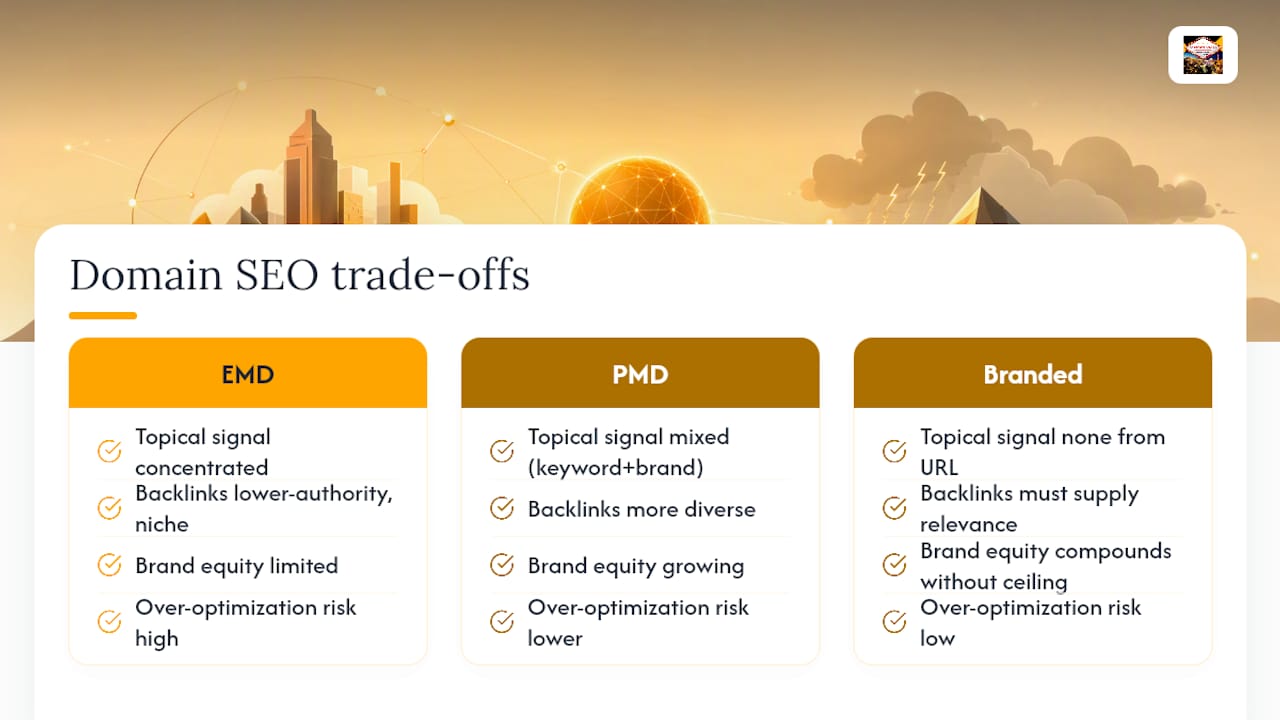
A partial match domain splits the difference. VegasWeddingPlanner.com signals both the keyword and a brand identity. Anchor text varies naturally because the domain has a name, not just a phrase. Over time, PMDs tend to build more diverse link profiles and stronger branded search volume than pure EMDs.
A branded domain starts with no topical signal from the URL itself, which means the content and links have to do all the relevance work. The trade-off is brand equity that compounds without a ceiling. Airbnb doesn't rank for "vacation rentals" because of its domain — it ranks because of authority, content, and brand signals at scale.
For most long-term projects, the brand-led domain strategy Search Engine Land advocates is the right call. EMDs and PMDs serve specific, bounded use cases — not every site, and not forever.
Successful and unsuccessful modern EMD case studies
Hotels.com is the clearest success story. The domain is an EMD, but it ranks because of massive content investment, thousands of authoritative backlinks, and a brand that users actively search by name. The EMD is a historical artifact of smart early acquisition, not the reason for current rankings.
Food.com follows a similar pattern: the domain matches a broad query, but the site's authority comes from years of user-generated recipe content and a strong backlink profile. Strip away the content and the domain alone would rank for nothing.
On the unsuccessful side, the post-2012 graveyard is full of thin affiliate sites that bought keyword domains and published minimal content. Cheapflightsbooking.com-style domains with no real content, no brand identity, and no authority signals were exactly what the 2012 EMD update targeted. Many never recovered.
The pattern is consistent: EMDs that succeed in 2026 are sites where the domain happens to match a keyword, not sites where the domain is the strategy. The URL is a supporting signal, not the foundation.
Keyword research aligned with an EMD strategy
If you're committed to an EMD or PMD, keyword research has to come before domain selection, not after. The process:
- Identify the core query your site will target — ideally a phrase with clear commercial or informational intent, measurable search volume, and a realistic competitive gap.
- Check trademark status using the USPTO database before you register anything. A keyword phrase that overlaps with a registered trademark is a legal liability, not an SEO opportunity.
- Evaluate SERP composition for the target phrase. If the top results are all high-authority brands, an EMD won't close that gap — content and links will have to do the work regardless of the domain.
- Assess long-tail expansion potential. A domain built around one head term needs to support a cluster of related queries. Use tools like Google Search Console, Ahrefs, or SEMrush to map the topic's full keyword universe before committing.
- Check domain availability across TLDs. If the .com EMD is taken or priced beyond budget, a .VEGAS, .co, or branded alternative may serve the strategy better than a hyphenated fallback.
The keyword-to-domain alignment only matters if the content strategy can sustain it. A domain that matches a query but hosts thin or off-topic content will underperform a branded domain with authoritative, comprehensive coverage every time.
How EMDs interact with Bing, Yahoo, and other search engines
Google's 2012 EMD update set the industry standard, but other engines have their own histories with keyword domains.
Bing has historically weighted domain keywords more explicitly than Google, and some practitioners report that EMDs still produce a modest direct relevance signal on Bing for competitive queries. Bing's 2024 quality updates narrowed this gap, but the engine remains slightly more receptive to keyword-matching domains than Google — particularly for local and commercial queries where topical clarity matters.
Yahoo's organic results are served by Bing, so the same dynamics apply. DuckDuckGo draws on Bing's index for many results, meaning EMD behavior on Bing broadly carries over there as well.
For international search engines like Baidu or Yandex, keyword domains in the local language can carry more direct weight than they do on Google, but those markets require separate keyword research and localization strategies that go beyond domain choice.
The practical takeaway: if your audience skews toward Bing (older demographics, enterprise Windows users, Microsoft Edge defaults), an EMD or PMD may deliver a slightly stronger direct signal than on Google. Don't build a strategy around that difference, but don't ignore it either.
The domain decision nobody talks about honestly
The honest take on EMDs in 2026 is that most of the debate misses the real question. Marketers spend time asking "does the domain name help rankings?" when the more useful question is "does this domain name build a business?"
Hotels.com and food.com are EMDs that work. They work because the companies behind them invested in content, authority, and brand over years. The domain was a head start, not a strategy. For every hotels.com, there are thousands of keyword domains sitting on expired hosting because the owner thought the URL would do the work.
The smarter play for most founders and marketers is a brand-led name with selective EMD or PMD acquisitions for specific, high-revenue use cases. Own your brand domain. Then, if a critical revenue keyword has a clean, affordable EMD available and no trademark risk, acquire it as a supporting asset — redirect it, build a dedicated landing page, or use it for a campaign. Don't build your primary brand identity on it.
Local TLDs like .VEGAS change this calculus. A domain like WEDDINGS.VEGAS isn't a generic keyword string — it's a location-branded asset that signals both category and geography in a way that compounds with offline marketing. That's a different value proposition than a .com EMD, and for Las Vegas businesses, it's often the stronger one.
Sources
- Ranking systems guide
- Value of an exact match domain. : r/SEO
- What is Exact Match Domain (EMD)?
- Exact Match Domains Guide: Is an EMD Worth It in 2026?
- Why I believe Exact Match Domains (EMDs) are back in SEO