
Negotiating a domain price is the practice of making strategic offers below a seller's asking price to reach a fair market value for a web address you want to own. Most negotiated domain sales close 10%–25% below the seller's original ask. That gap represents real money for your business. The key to capturing it is preparation: knowing what the domain is actually worth, anchoring your first offer correctly, and protecting your identity throughout the process.
How to negotiate domain price: valuation and budget
Domain valuation is the process of estimating a domain's fair market value before you make any offer. Without a defensible number, you are negotiating blind.
Domain prices fall into three broad tiers. Parked or low-interest domains typically sell in the low four figures. Brandable, keyword-rich domains land in the mid five figures. Premium one-word .com domains can exceed $1,000,000, while registry-reserved names range from $100 to $5,000. Knowing which tier your target sits in sets the ceiling for your entire negotiation.
| Tier | Example type | Typical price range | Opening offer anchor |
|---|---|---|---|
| Low-interest / parked | Generic, low-traffic | $500–$4,000 | $200–$1,600 |
| Brandable / keyword | Short, memorable | $5,000–$50,000 | $2,000–$20,000 |
| Premium / one-word | Single-word .com | $50,000–$1,000,000+ | $20,000–$400,000 |
| Registry-reserved | TLD-specific names | $100–$5,000 | $40–$2,000 |
Once you know the tier, calculate your midpoint valuation using comparable sales data from domain marketplaces. Then set your opening offer at roughly 40% of that midpoint. That anchor creates room to negotiate upward while keeping the final price inside your budget. Never anchor to the seller's asking price. Sellers build a negotiation buffer into their ask, so treating it as market value means you start from an inflated baseline.
Pro Tip: Use round, clean numbers for your opening offer. A figure like $2,000 reads as considered and deliberate, while $1,987 signals that you are already at your limit.

What messaging tactics work best when making an offer on a domain?
Your first message to a seller sets the tone for everything that follows. Keep it short, professional, and free of any detail that reveals why you want the domain or what your business does.
Effective tactics include:
- Stay anonymous. Keeping your identity private prevents sellers from researching your company and inflating the price based on your perceived budget. Use a neutral email address with no brand name in it.
- Anchor low but not insultingly low. Opening offers typically land 40%–60% below the asking price on "Make Offer" listings. This creates space to move up while keeping the final number in your range.
- Never reveal your intent. Telling a seller you need this domain for your new Las Vegas restaurant gives them pricing power. Say you are evaluating several options.
- Use a broker for high-value deals. Hiring a professional domain broker is cost-effective for acquisitions above $10,000 or when anonymity is critical. Broker fees typically run 10%–15%, but the savings on a premium deal far exceed that cost.
- Propose escrow early. Offering to use escrow signals that you are a serious buyer. Most sellers respond positively because it removes their risk.
A sample opening email looks like this: "Hi, I came across [domain.com] and wanted to reach out about a potential purchase. I'm currently evaluating a few options and can offer $[X]. Please let me know if you'd like to discuss." That is it. No company name, no urgency, no flattery.
Pro Tip: Offer to cover the escrow fee yourself. It costs you a small amount but removes a friction point for the seller and signals professionalism without revealing your budget.
What does the domain negotiation process look like step by step?
The negotiation process follows a predictable sequence. Knowing each phase helps you stay calm and make better decisions at every turn.
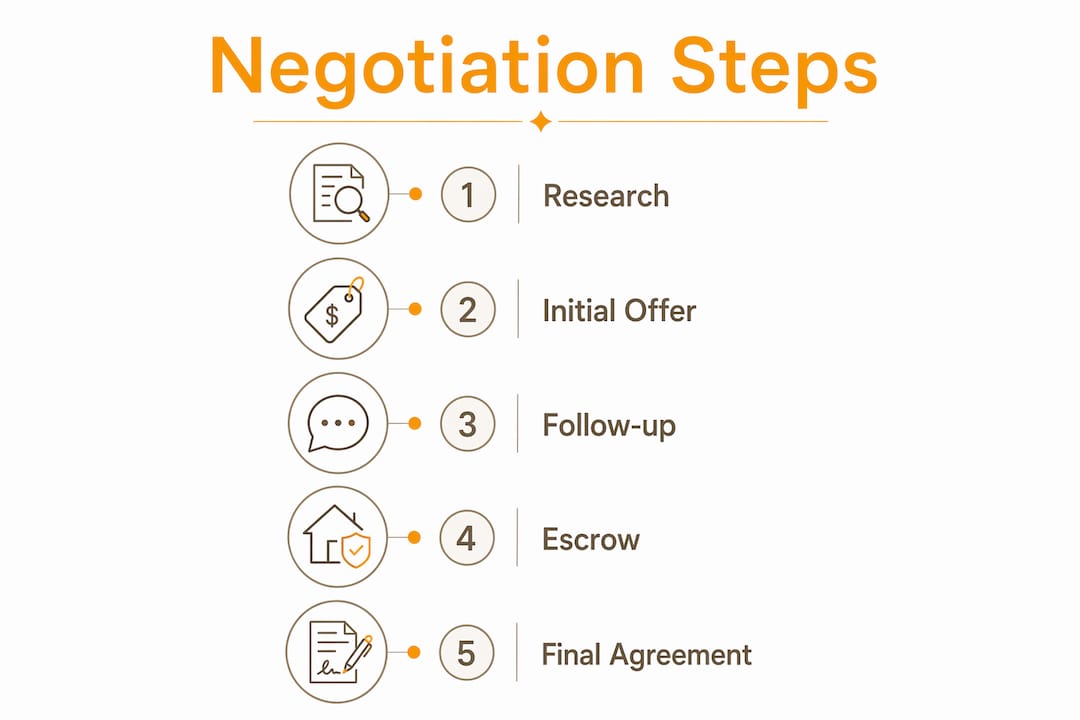
- Research and value the domain. Pull comparable sales, assess the TLD, keyword strength, and length. Set your maximum budget before you contact anyone.
- Send your opening offer. Use a neutral email. Keep it brief. Anchor at 40% of your valuation midpoint.
- Expect a counter. Sellers almost always counter. A counter within 10%–25% of their original ask is a good sign. It means they are willing to deal.
- Make a measured second offer. Move up from your anchor, but not all the way to your ceiling. Leave room for one more round.
- Propose escrow. Once both sides are close, introduce escrow as the payment method. Offering escrow early removes the risk premium sellers often build into their price.
- Watch for red flags. Pressure tactics, refusal to use escrow, and demands for wire transfers to personal accounts are all warning signs. Walk away from any seller who refuses a standard escrow arrangement.
- Know your walk-away number. Set this before you start. Failing to set a ceiling is one of the most common mistakes buyers make. If the seller will not come below your maximum, leave the conversation.
- Close and transfer. Once price is agreed, complete the transfer through escrow. Confirm the domain is fully transferred to your registrar before releasing funds.
Patience is your biggest asset here. Sellers who receive no follow-up often come back with a lower number days or weeks later.
How do you handle common domain bargaining challenges?
Not every negotiation goes smoothly. Sellers get emotional, listings are rigid, and sometimes the price just does not move.
Fixed "Buy Now" listings are the hardest situation. These listings leave little room for back-and-forth. Your options are to pay the listed price, wait for the seller to lower it, or walk away. Patience and having alternative domains ready are your only real levers here.
When a seller is emotionally attached to a high price, reframe the conversation around their net proceeds. Instead of arguing about the headline price, ask what they would actually take home after marketplace fees and taxes. That shift often moves the number more than any counter-offer argument.
Staying objective is non-negotiable. Emotional overbidding happens when a buyer convinces themselves that only one domain will work. Having two or three viable alternatives ready before you start negotiating gives you real leverage. If you can genuinely walk away, sellers feel it.
- Identify alternative domains or TLDs before starting any negotiation. A .VEGAS domain, for example, can be a strong brand choice for Las Vegas-focused businesses and often comes at a fraction of the cost of a premium .com.
- Reframe net proceeds to shift the seller's focus from asking price to what they actually receive.
- Stay silent after making an offer. Silence creates pressure. Buyers who fill the silence with justifications signal desperation.
- Set a firm deadline on your offer. "This offer is available through Friday" creates urgency without aggression.
Pro Tip: Never make your final offer in the first two rounds. Sellers expect movement. If you jump to your ceiling too fast, you lose all remaining leverage.
Key Takeaways
Successful domain price negotiation requires preparation, anonymity, and a firm walk-away number set before the first offer is made.
| Point | Details |
|---|---|
| Anchor your opening offer | Start at 40% of your valuation midpoint to create room for negotiation. |
| Protect your identity | Use a neutral email and avoid revealing your business name or intent. |
| Use escrow from the start | Proposing escrow early signals professionalism and reduces seller resistance. |
| Know your walk-away price | Set your maximum budget before contacting the seller and stick to it. |
| Have alternatives ready | Viable backup domains give you real leverage and prevent emotional overbidding. |
Why patience is the most underrated negotiation tool
I have watched entrepreneurs overpay for domains by thousands of dollars because they convinced themselves a specific name was irreplaceable. That belief is almost always wrong, and sellers can sense it.
The buyers who get the best deals share one trait: they are genuinely prepared to leave. They have done the valuation work, they have a list of backup options, and they contact sellers from a neutral email with no company branding. They do not explain why they want the domain. They do not respond within minutes of every counter. They let silence do the work.
The anonymity piece is more important than most people realize. Domain brokers add real value precisely because they remove the buyer's identity from the conversation entirely. For any deal above $10,000, the broker fee pays for itself in the discount it creates.
The mistake I see most often from first-time buyers is treating the seller's asking price as a starting point for their own thinking. It is not. It is a ceiling the seller invented. Your valuation, built from comparable sales and domain metrics, is the only number that matters. Start well below it, move slowly, and let the seller come to you.
— Shawn
Getyour.Vegas: your edge in domain acquisition
You have the strategy. Now you need the right domain and the right process to close the deal.

Getyour specializes in .VEGAS domain names, giving Las Vegas businesses a direct path to a memorable, location-specific brand identity. Whether you want to lease a domain with flexible terms or make an offer on a specific name, Getyour handles the process with secure transactions and expert guidance. Clients like WEDDINGS.VEGAS have used this approach to build instant brand recognition in a competitive market. If you are ready to acquire a .VEGAS domain without the guesswork of a cold negotiation, Getyour is the place to start.
FAQ
What is a fair opening offer on a domain?
A fair opening offer sits 40%–60% below the seller's asking price on a "Make Offer" listing. This anchors the negotiation below the seller's buffer and creates room to reach a final price 10%–25% below the original ask.
Should I reveal my business when contacting a domain seller?
No. Keeping your identity and business purpose private prevents sellers from inflating the price based on your perceived budget or the domain's strategic value to your brand.
When should I hire a domain broker?
Hire a broker for acquisitions above $10,000 or when anonymity is critical. Broker fees typically run 10%–15% but often produce savings that exceed the cost on high-value deals.
What is escrow and why does it matter in domain deals?
Escrow is a third-party service that holds payment until the domain transfer is confirmed. Proposing escrow early signals buyer seriousness and removes the risk premium sellers often build into their price.
What should I do if a seller refuses to negotiate?
Check whether the listing is a fixed "Buy Now" or a "Make Offer" listing. Fixed listings leave little room for bargaining, so your best options are to wait, find an alternative domain, or walk away and revisit the seller later.