
Should you use a hyphen in your domain name? The short answer: you can, but think carefully before you do. Hyphens are technically valid in domain names, they do not trigger any Google penalty, and they can genuinely improve readability in specific situations. The trade-off is real, though. Hyphenated domains often carry a perception problem in the US market, and that perception can affect trust and memorability.
Here is the balanced view before you dive deeper:
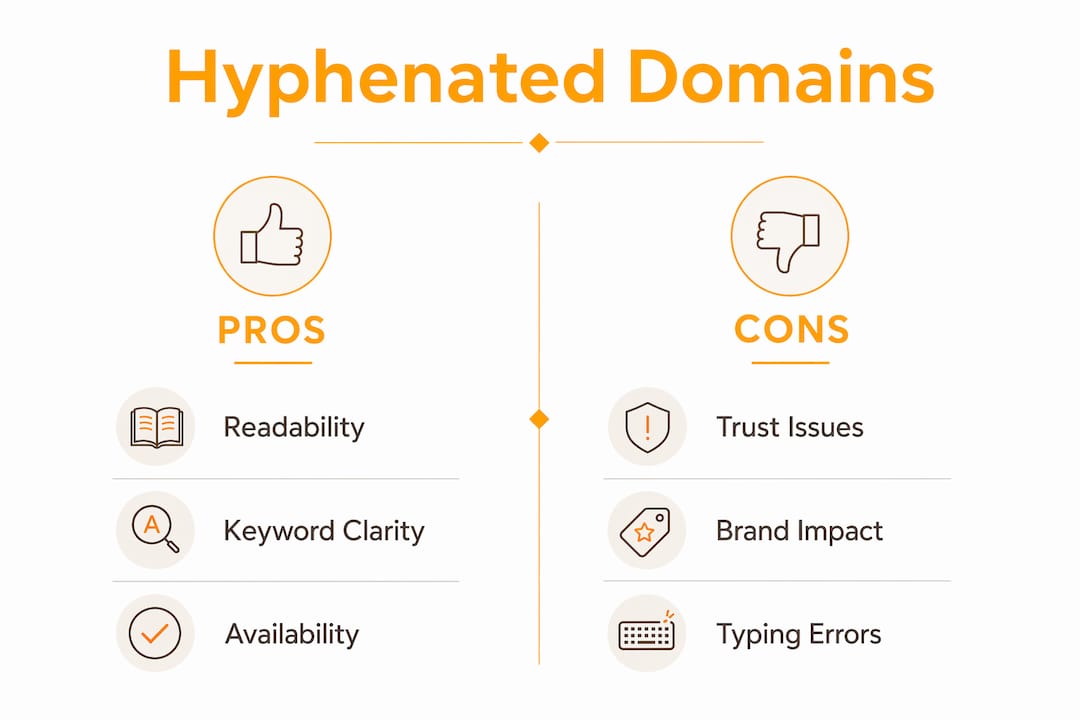
- Allowed: Hyphens are valid domain characters but cannot appear at the start or end of a domain label.
- SEO neutral: Google does not penalize hyphenated domains directly.
- Readability win: Hyphens separate words clearly, which helps users parse compound phrases.
- Trust risk: US audiences often associate hyphenated domains with spam or low-quality sites.
- Memorability loss: Users frequently forget or skip hyphens when typing, sending traffic to a competitor or a dead URL.
- Availability upside: Hyphenated versions of popular names are often available when the clean version is taken.
The decision comes down to your brand goals, your audience, and how the domain will actually be used.
Table of Contents
- Are hyphens allowed in domain names and URLs?
- What are the real pros of using a hyphenated domain?
- What are the real cons of hyphenated domains?
- How do hyphens actually affect your SEO?
- When should you use hyphens in your domain name?
- How do hyphens affect your brand's readability and trust?
- Domain registration best practices for hyphenated domains in the US market
- Getyour: your edge in the .VEGAS domain market
- Key Takeaways
Are hyphens allowed in domain names and URLs?
Yes, hyphens are fully permitted characters in domain names under established internet standards. RFC 3696 and DNS naming conventions both allow hyphens within domain labels. The one hard rule: a hyphen cannot be the first or last character of any label. So my-brand.com is valid; -mybrand.com and mybrand-.com are not.
There is also an important distinction between hyphens in a root domain and hyphens in URL paths. Google's own guidelines recommend hyphens in URL slugs and file names because their algorithms parse them cleanly as word separators. That recommendation applies to sub-page URLs like /best-las-vegas-venues, not necessarily to the root domain itself. Treating these two contexts as identical is one of the most common mistakes people make when researching this topic.
- Hyphens in root domains: technically valid, but carry branding and trust implications.
- Hyphens in URL paths: actively recommended by Google for readability and indexing.
- Underscores in URLs: not recommended by Google because their segmenter cannot reliably split words at underscores.
- Hyphens cannot begin or end a domain label according to DNS standards.
What are the real pros of using a hyphenated domain?
Hyphenated domains get a bad reputation, but there are genuine situations where they make sense. Here is what actually works in their favor.

Readability is the strongest argument. When a domain name contains multiple words, a hyphen makes the boundary between them obvious. Compare speedreading.com to speed-reading.com. The second version is instantly clearer, especially for first-time visitors who encounter the URL in print, on a business card, or in a social media bio. SEO analysis confirms that hyphens improve URL readability for both humans and search engines.
Availability is a practical reality. Clean, non-hyphenated .com domains for common phrases are often unavailable. If vegasevents.com is taken or priced at a premium, vegas-events.com might be available at standard registration cost. For a new business watching its budget, that difference matters.
- Hyphens clarify compound words that would otherwise be ambiguous or hard to parse.
- They provide a naming option when the preferred non-hyphenated domain is unavailable or prohibitively expensive.
- Hyphens can subtly reinforce keyword clarity in the domain, which may support indexing.
- They work well for descriptive, niche, or long-tail domains where readability outweighs brand recall concerns.
- Google's John Mueller has noted that hyphens can be useful when they genuinely help users understand the domain name.
What are the real cons of hyphenated domains?
The downsides are significant enough that most branding professionals steer clients away from hyphens in root domains unless there is a compelling reason to use them.
Trust is the biggest problem. US audiences have been conditioned to associate hyphenated domains with spam sites, affiliate farms, and low-quality content. That perception is not always fair, but it is real. A study of SEO community consensus found that hyphenated domains are often perceived as spammy or lower quality, which affects click-through rates and user confidence before a visitor even lands on your page.
Typing errors cost you traffic. When someone hears your domain name spoken aloud, they will almost certainly type it without the hyphen. If you own best-vegas-deals.com but not bestvegasdeals.com, you are handing traffic to whoever owns that clean version. This is not a hypothetical. It is a consistent pattern in user behavior research.
- Hyphenated domains are harder to communicate verbally, especially in radio, podcast, or word-of-mouth contexts.
- Mobile users find hyphens particularly inconvenient to type, increasing the chance of errors or abandonment.
- Multiple hyphens compound every problem: trust drops further, memorability collapses, and the domain starts to look machine-generated.
- Hyphens reduce branding simplicity. A clean, single-word or compound domain signals confidence and authority.
- Security risk: bad actors can register the non-hyphenated version of your domain and use it for phishing or typo-squatting, exploiting the confusion your hyphen creates.
How do hyphens actually affect your SEO?
The direct answer from Google is clear: hyphenated domain names do not receive a search ranking penalty. John Mueller confirmed this explicitly, stating that hyphenated domains are fine for SEO and that no silent penalties exist for using them. That should settle the myth.
What does affect SEO, indirectly, is user behavior. If your domain looks spammy, users may skip your result in the SERP. Lower click-through rates can signal to Google that your page is less relevant, which may suppress rankings over time. The hyphen itself is neutral; the perception it creates is not.
- Google's algorithm parses hyphens efficiently as word separators in URLs, which supports indexing of individual keywords.
- Underscores do not get the same treatment. Google's Gary Illyes confirmed the segmenter cannot reliably split at underscores, making hyphens the clear technical choice for URL paths.
- Domain-level hyphens have no direct ranking effect, but secondary signals like bounce rate, CTR, and backlink acquisition can be influenced by trust perception.
- A hyphenated domain that earns fewer backlinks because it looks less credible will rank below a clean domain with equivalent content.
- The SEO impact of hyphens is best described as neutral at the algorithm level, but potentially negative at the human behavior level.
Pro Tip: If you are building a content-heavy site with many sub-pages, invest in a clean root domain and use hyphens freely in your URL slugs. That is where Google actually recommends them.
When should you use hyphens in your domain name?
There is no universal answer, but there are clear scenarios where a hyphenated domain is the right call and others where it will hurt you.
Use a hyphen when readability genuinely suffers without it. Some word combinations create unintended readings when concatenated. The classic example is a domain that accidentally spells something offensive or confusing when the words run together. A hyphen solves that problem cleanly.
Consider a hyphen when the clean version is gone. If the non-hyphenated domain is taken and you cannot acquire it at a reasonable price, the hyphenated version is a legitimate fallback, especially for local or niche businesses where the domain is one of many brand touchpoints rather than the primary one.
- Avoid using multiple hyphens, as they can signal lower quality to many US users.
- Factor in how your audience will encounter the domain. Print and audio contexts make hyphens harder to communicate accurately.
- If your market is primarily local, like Las Vegas businesses, a distinctive domain extension can often solve the availability problem without any hyphen at all.
- Test the domain by saying it aloud to someone unfamiliar with it. If they type it correctly without prompting, the hyphen is working. If they drop it, you have a traffic leak.
- Consider registering both the hyphenated and non-hyphenated versions and redirecting one to the other, if budget allows.
For digital marketing strategy, the domain name is one piece of a larger brand architecture. A hyphen that solves a real problem is better than a clean domain that creates a different one.
How do hyphens affect your brand's readability and trust?
Brand perception is where hyphens do the most damage, and it is the factor most people underestimate when they are focused on availability and SEO.
A domain name is a first impression. In the US market, clean domains signal confidence. Hyphenated ones often signal that the clean version was unavailable, which subtly communicates that the brand arrived late or is operating in a crowded space. That is a subconscious signal, but it lands.
The cultural dimension matters. Research on international domain name perception shows that some European markets, particularly German-speaking regions where compound words are standard, accept hyphenated domains as normal. English-speaking markets, including the US, view them with more skepticism. If your audience is primarily American, that skepticism is a real factor in your conversion rate.
- Hyphens complicate word-of-mouth sharing. "Go to best-vegas-deals dot com" is harder to say and remember than "Go to BestVegasDeals dot com."
- Brands using hyphenated domains should invest more heavily in consistent visual branding to compensate for the domain's reduced memorability.
- Keeping the domain short, ideally two words with one hyphen at most, limits the damage to recall.
- Users unfamiliar with hyphenated domains may hesitate before clicking, especially in email or SMS contexts where the full URL is visible.
- Testing audience reactions before committing to a hyphenated domain is worth the effort. A quick survey or A/B test on social media can reveal how your specific audience responds.
Domain registration best practices for hyphenated domains in the US market
If you have decided a hyphenated domain is right for your situation, register it strategically. The US domain market is competitive, and a few practical steps will protect your investment.
Register the non-hyphenated version too, if it is available. Even if you plan to use the hyphenated domain as your primary address, owning the clean version and redirecting it prevents a competitor or bad actor from capturing your traffic. This is especially important if your brand name is a common phrase.
Stick to .com for US audiences. American users default to typing .com. If your hyphenated domain is a .net or .org, you face a double trust challenge: the hyphen and the non-standard extension. For Las Vegas businesses, a .VEGAS extension is a sharp alternative that sidesteps the hyphen problem entirely while signaling local authority. Domains like WEDDINGS.VEGAS demonstrate how a clean, memorable address can anchor a brand without any punctuation compromise.
- Register your domain through an ICANN-accredited registrar. In the US, options include major registrars that offer WHOIS privacy, auto-renewal, and two-factor authentication.
- Enable WHOIS privacy protection to reduce spam and protect your personal information.
- Set up auto-renewal. Losing a domain because of a missed renewal is a preventable disaster.
- If you are in a competitive niche, consider registering common misspellings and redirecting them to your primary domain.
- Avoid hyphens at the end of a label entirely. Beyond being technically invalid, they look like a truncation error to users.
- For Las Vegas businesses specifically, the .VEGAS extension offers a clean, hyphen-free path to a memorable domain. Getyour specializes in leasing premium .VEGAS domains that give local brands instant geographic authority without the trust penalties that come with hyphenated .com names.
Working with a domain naming specialist during your brand launch can save you from a domain decision you will want to reverse in two years.
Getyour: your edge in the .VEGAS domain market

You do not have to choose between a hyphenated domain you can afford and a clean domain you cannot. Getyour offers premium .VEGAS domain leases and sales that give your Las Vegas brand a distinctive, memorable address with zero punctuation compromise. Whether you are launching a new venture or repositioning an existing one, a .VEGAS domain cuts through the noise in a way that best-your-thing-vegas.com never will.
Ready to claim your domain? Make an offer and let Getyour put the right address behind your brand.
Key Takeaways
Hyphens in domain names are technically valid and SEO-neutral at the algorithm level, but their impact on user trust and memorability in the US market makes them a choice that demands careful consideration.
| Point | Details |
|---|---|
| Hyphens are allowed, with limits | Valid in domain names per RFC 3696, but cannot start or end a domain label. |
| No direct SEO penalty | Google's John Mueller confirmed hyphenated domains carry no ranking penalty from the algorithm. |
| Trust perception is the real risk | US audiences often associate hyphenated domains with spam, which can suppress click-through rates. |
| URL paths vs. root domains | Google recommends hyphens in URL slugs for readability; that recommendation does not extend to root domain names. |
| Clean alternatives exist | A .VEGAS domain offers a memorable, hyphen-free option for Las Vegas businesses facing .com availability issues. |