
A lease-to-own (LTO) domain is a payment-plan purchase: you pay monthly installments, use the domain immediately, and gain full ownership after the final payment clears. These arrangements are widely available in the U.S. through major marketplaces and specialist sellers. Unstoppable Domains, GoDaddy, and Spaceship's SellerHub all offer LTO features. For .VEGAS names specifically, GET YOUR VEGAS provides lease and make-an-offer services built around documented contracts and escrow guidance.
If you're ready to act, search LTO listings on those platforms or contact a specialist directly. If you want to understand the mechanics, pricing, and risks before committing, keep reading.
Table of Contents
- How a lease-to-own domain actually works
- Who benefits from domain LTO, and when it makes sense
- What pricing and contract terms actually look like
- How and when ownership actually transfers to you
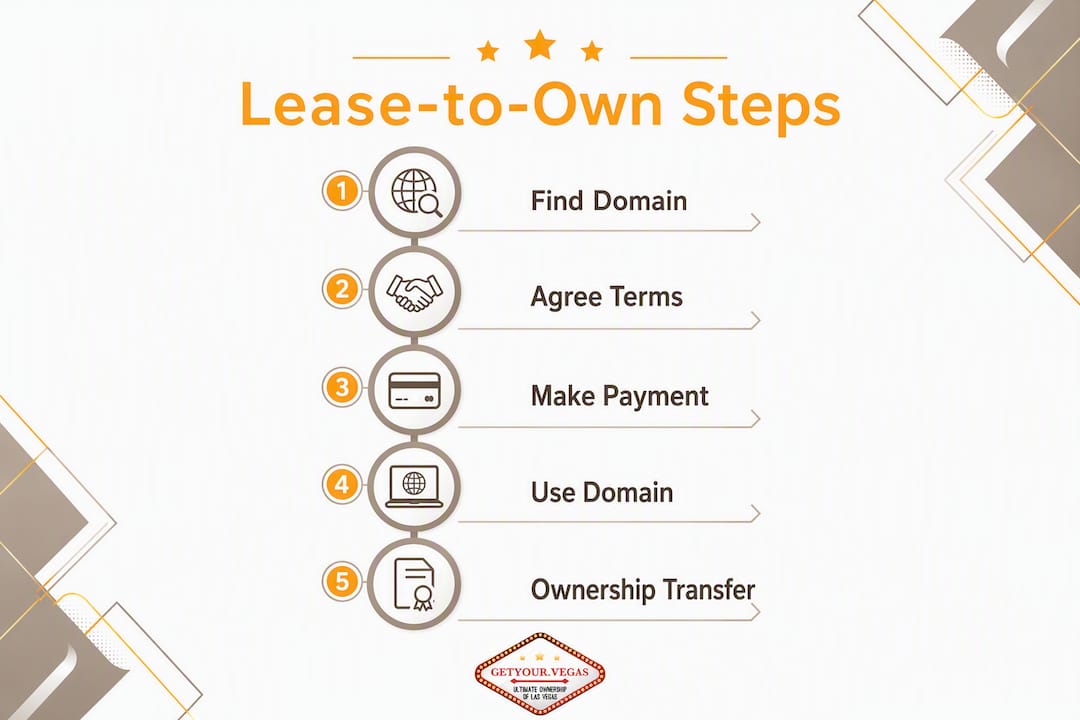
- Step-by-step: how to buy or list a domain on an LTO plan
- Risks and red flags to watch before you sign
- Alternatives to LTO and when they're the better choice
- When to use LTO and what to do next
- Key Takeaways
- Why GET YOUR VEGAS supports LTO for .VEGAS domains
- GET YOUR VEGAS lease and make-an-offer services
- Authoritative sources and platform references
How a lease-to-own domain actually works
The industry term for this model is domain installment purchase or domain LTO, and the mechanics are straightforward once you see both sides of the transaction.
Buyer flow. You find a domain listed with an LTO option, agree on the total price, term length, and any down payment, then set up automatic monthly payments. The domain activates immediately, so your website or email goes live while you're still paying. Ownership transfers to you only after the final installment clears.

Seller flow. The seller sets the total price, acceptable term range, and minimum monthly payment, then enables LTO on the listing. They receive monthly payouts (minus platform fees) while retaining title until the contract completes. If the buyer defaults, the seller reclaims the domain.
Escrow and transfer timing. Most platforms hold the domain in escrow or restrict registrar transfers until the final payment is confirmed. The buyer gets DNS control and can operate the domain, but the registrant record stays with the seller or a custodial account. Transfer of the registrant record happens at contract completion, not at signing.
What happens when payments are missed. Platforms typically allow a short grace window after a missed payment. DNS forwarding or resolution may be suspended if the account goes overdue beyond that window. A second, longer overdue period usually triggers termination and repossession, with all prior payments forfeited. The exact windows vary by platform, so always read the termination clause before signing.
Unstoppable Domains' LTO feature illustrates the range well: eligible domains can be enabled for lease-to-own if they are priced between $240 and $2,000,000—terms are configurable up to 120 months, with a minimum installment of $50. A real transaction on that platform showed an example of a domain leasing deal with monthly payments, enabling a sale that might not have closed with an outright cash purchase.
| Role | Key action | When ownership changes |
|---|---|---|
| Buyer | Pays monthly, uses domain immediately | After final payment |
| Seller | Receives monthly payouts, holds title | Retains title until completion |
| Platform/Escrow | Holds domain or restricts transfer | Releases registrant record at completion |
Who benefits from domain LTO, and when it makes sense
LTO shifts domain acquisition from a capital expense into an operating expense, which is exactly how startups and SMBs manage equipment, software, and office space. That framing matters: instead of draining a launch budget on a single domain purchase, you allocate a predictable monthly line item.
Buyer benefits at a glance:
- Secure a preferred name immediately without a large upfront outlay
- Spread cost across months or years to protect working capital
- Reduce rebrand risk by locking in the name before a competitor does
- Align domain cost with revenue growth during the payment term
Seller benefits:
- Expand the buyer pool to include businesses that can't pay cash upfront
- Generate recurring monthly income from names that might otherwise sit idle
- Maintain asking price integrity while increasing the chance of a sale
- Selectively enable LTO on mid-tier inventory to balance lump-sum and recurring revenue
Who it suits most. An early-stage startup launching a product line can secure a premium name on day one without depleting seed capital. A local Las Vegas business rebranding to a .VEGAS domain can start using the name immediately while spreading the cost over 12 or 24 months. An investor with a large portfolio can list slower-moving assets with LTO enabled and convert stalled inventory into monthly cash flow.
Short-term campaigns where you need a name for six months and nothing more are a different story. LTO is built for buyers who intend to own the domain long-term.
What pricing and contract terms actually look like
Contract terms vary by platform and seller, but a few patterns hold across the market. Most platforms allow terms ranging from short to extended durations, with minimum monthly payments starting at a relatively low amount, though some brokers and marketplaces advertise no-interest installment options on shorter plans.
Fee items to check before signing:
- Platform commission (taken from seller payouts, but affects how sellers price the deal)
- Payment processing fees (sometimes passed to the buyer)
- Late fees and reinstatement fees if payments lapse
- KYC or identity verification costs on regulated platforms
- Any escrow setup fee for brokered private deals
Worked examples — how term length changes your monthly payment:
| Domain price | Term | Monthly payment | Total paid |
|---|---|---|---|
| — | 12 months | — | — |
| — | 24 months | — | — |
| — | 24 months | — | — |
*Longer terms may include a small premium; verify with the specific platform.
Negotiation levers. A larger down payment often unlocks a lower monthly floor. Offering to shorten the term can persuade a seller to accept a slightly lower total price. Always ask about an early payoff clause — paying off the balance ahead of schedule should not trigger a penalty, but some contracts are silent on this. Get it in writing.
Pro Tip: Before accepting a seller's default term, run the numbers on two or three term lengths. Shorter payment terms result in higher monthly payments, while longer terms reduce monthly costs for a given domain price. The right term depends on your cash flow, not just the monthly number.
How and when ownership actually transfers to you
The standard in LTO agreements is that the registrant record changes only after the final payment is confirmed. Until then, you have DNS control and operational use of the domain, but the WHOIS record shows the seller or a custodial escrow account as the registrant.
Transfer checkpoints to verify before signing:
- Who is listed as registrant in WHOIS during the term?
- Who controls DNS settings, and can you update them freely?
- Is the domain held in a third-party escrow account or with the seller's registrar?
- What is the documented trigger for the registrant transfer after final payment?
- How long does the transfer take after the final payment clears?
The escrow role. Platforms implement escrow-like safeguards in different ways. Some hold the domain in a dedicated custodial account. Others keep it in the seller's registrar account but restrict outbound transfers via a registrar lock. Either approach protects the seller from a buyer who stops paying and the buyer from a seller who tries to sell the domain to someone else mid-term. Confirm which method applies to your specific listing.
U.S.-specific practical notes. Tax treatment can vary: some accountants treat LTO payments as installment purchase payments toward an asset, while others treat them as lease expense. The contract language often determines which treatment applies, and the difference affects your deductions. Registrar-specific transfer policies also matter. Some registrars impose a 60-day transfer lock after any account change, which can delay the final transfer even after your last payment clears. Confirm the registrar's policy before you sign.

This is general information, not tax or legal advice. Consult a qualified accountant or attorney for guidance specific to your situation.
Pro Tip: Request a written confirmation of each payment and a copy of the escrow or custody agreement before the domain goes live. If the platform doesn't provide these automatically, ask. A paper trail protects you if there's a dispute at the end of the term.
Step-by-step: how to buy or list a domain on an LTO plan
Buyer checklist
- Search for LTO-enabled listings on platforms like GoDaddy's LTO marketplace, Unstoppable Domains, or Spaceship's SellerHub.
- Compare monthly payment, term length, total price, and down payment options across listings.
- Verify escrow or custody arrangement and confirm the transfer trigger after final payment.
- Complete any required KYC or identity verification before payment setup.
- Set up automatic payments and save the payment confirmation for each installment.
- Document the full agreement, including default cure periods and early payoff terms.
- Confirm DNS access and test that the domain resolves correctly before your launch date.
Seller checklist
- Appraise the domain and set a total price that reflects fair market value (check recent comparable sales).
- Decide on acceptable term ranges and a minimum monthly payment floor.
- Enable LTO on your listing through the platform's seller tools (GoDaddy's Afternic, Unstoppable Domains' seller dashboard, or Spaceship's SellerHub).
- Set your reinstatement policy and late-fee terms clearly in the listing.
- Prepare or review the platform's standard LTO contract; for private deals, use a third-party escrow service.
- Monitor monthly payouts and track remaining payments against the contract schedule.
Platform policy pages are the authoritative source for exact parameters. Spaceship's SellerHub announcement and Unstoppable Domains' LTO announcement both detail their specific term limits, fee structures, and seller setup flows. Check those pages directly, since parameters update periodically.
Pro Tip: Offer a seller a larger down payment in exchange for a lower monthly rate or a shorter total term. Most sellers prefer cash certainty upfront. That single negotiation move can save you hundreds on a mid-range domain and gives the seller confidence you're a serious buyer. For more tactics, the domain price negotiation guide at GET YOUR VEGAS covers this in detail.
Risks and red flags to watch before you sign
LTO agreements are straightforward when both parties follow the contract. The problems arise when the contract is vague or one-sided.
Primary risks for buyers:
- Repossession after a single missed payment with no cure window
- Unclear or absent transfer trigger language after final payment
- Excessive reinstatement fees that make catching up more expensive than defaulting
- Seller retaining DNS control, which could disrupt your site mid-term
- Registrar lock delays that postpone ownership transfer weeks after your last payment
Primary risks for sellers:
- Buyer uses the domain for months, then defaults, leaving the seller to reclaim and re-list
- Inadequate escrow means a dispute requires legal action to resolve
- Ambiguous contract language that a buyer uses to contest repossession
Red-flag contract clauses to reject:
- Default defined as any payment more than 24 hours late with no grace period
- Seller unilateral termination rights with no refund of prior payments
- No documented escrow or custody arrangement
- Ownership transfer language that says "at seller's discretion" rather than specifying a trigger
- Late fees with no cap
Mitigations that protect you:
- Insist on a third-party escrow account or a documented registrar lock arrangement
- Require a defined cure period (14 days is a reasonable standard) before any termination action
- Cap late fees at a fixed dollar amount per missed payment
- Include an early payoff clause with no penalty
- Get written payment receipts for every installment
Questions to ask before signing. What happens on day one of a missed payment? Day seven? Day fourteen? Who controls DNS during the term? How is the registrant transfer documented and executed after the final payment? If a seller or platform can't answer these clearly, that's your signal to walk away or negotiate better terms.
Alternatives to LTO and when they're the better choice
LTO is not always the right tool. Three other acquisition paths are worth knowing.
Outright purchase. When cash is available and you want immediate, unambiguous ownership, a direct purchase is cleaner. No ongoing payment obligation, no repossession risk, no contract to monitor. The tradeoff is a larger upfront outlay. For domain auction sites and direct sales, this is the standard model. Choose it when the domain is affordable outright and speed of transfer matters.
Short-term lease with no ownership path. Some sellers offer pure leases: you pay monthly for access but never acquire the domain. This suits temporary campaigns, event microsites, or brand tests where long-term ownership is unnecessary. The monthly cost is often lower than an LTO plan, but you build no equity and the seller can decline to renew.
Escrow-assisted installment or private financing. For high-value names, a brokered deal with bespoke terms can offer more protection than a marketplace LTO product. A domain broker negotiates the contract, structures the escrow, and manages the transfer. This costs more in fees but gives both parties more control over terms. Best for transactions above $50,000 where the standard platform terms feel limiting.
How to choose. If cash is available and transfer speed matters, buy outright. If you need the name now but cash is constrained, LTO is the right structure. If ownership is irrelevant and the campaign is short, a pure lease saves money. If the deal is complex or high-value, use a broker.
When to use LTO and what to do next
Use a lease-to-own domain arrangement when you need the domain now, intend to own it long-term, and want to spread the cost across your operating budget rather than take a capital hit upfront. Prefer an outright purchase when you have the cash, want immediate clean title, and the domain is priced within reach.
Your next step: search LTO listings on the platforms mentioned above, or contact a specialist directly. Before you commit, run a quick domain valuation using recent comparable sales, prepare your negotiation points (down payment size, preferred term, early payoff clause), and confirm the escrow and transfer mechanics in writing. If the deal is material to your business, have an attorney review the contract.
Key Takeaways
A lease-to-own domain lets you secure a premium name immediately and pay monthly, with full ownership transferring only after the final installment clears.
| Point | Details |
|---|---|
| Ownership transfers after final payment | You use the domain during the term, but the registrant record changes only when all payments clear. |
| Sellers gain recurring cash flow | LTO converts stalled premium inventory into monthly income while preserving the asking price. |
| Always verify escrow and transfer terms | Confirm who holds the domain, who controls DNS, and what triggers the registrant transfer before signing. |
| Negotiate down payment and early payoff | A larger down payment often lowers the monthly rate; an early payoff clause protects you from penalties. |
| GET YOUR VEGAS for .VEGAS names | GET YOUR VEGAS offers documented LTO lease agreements for .VEGAS domains, with escrow guidance and optional marketing add-ons. |
Why GET YOUR VEGAS supports LTO for .VEGAS domains
The case for LTO in the .VEGAS market is direct. Las Vegas businesses, event planners, and entrepreneurs often need a strong domain name at the exact moment they're launching, not six months later when the budget frees up. A lease-to-own structure lets a client secure WEDDINGS.VEGAS or SHOWS.VEGAS on day one while keeping working capital available for the actual business launch.
GET YOUR VEGAS has been operating in the .VEGAS domain space since 2009. The agency's experience spans leasing, direct sales, and auctions, plus billboard advertising integrations that let clients extend their .VEGAS brand into physical Las Vegas marketing. That combination is specific to this market and not something a general-purpose domain marketplace replicates.
On the process side, GET YOUR VEGAS uses documented contracts, transparent fee structures, and escrow practices that protect both the buyer and the seller. Clients know exactly what they're paying, when ownership transfers, and what happens if circumstances change. LTO financing expands the buyer pool by making premium names accessible to businesses at every stage, and that's the philosophy behind every lease arrangement GET YOUR VEGAS structures.
GET YOUR VEGAS lease and make-an-offer services
You've read the mechanics. Here's where it gets real for your brand.
GET YOUR VEGAS is the specialist for .VEGAS domain leasing in the U.S. market. While general marketplaces list thousands of extensions with standardized terms, GET YOUR VEGAS focuses exclusively on .VEGAS names, which means deeper inventory knowledge, market-specific pricing, and lease structures built around how Las Vegas businesses actually operate.

Every lease through GET YOUR VEGAS includes term setup, escrow guidance, and domain activation during the payment period so your brand is live from day one. Optional billboard advertising add-ons let you extend your .VEGAS domain into physical Las Vegas visibility, a combination no general-purpose platform offers. Contracts are documented, fees are transparent, and the transfer process is confirmed in writing.
Ready to secure your .VEGAS name? View current lease listings or make an offer on a specific domain. Both pages walk you through the next step in under two minutes.
Authoritative sources and platform references
Use these directly to verify platform policies, term parameters, and escrow mechanics before entering any agreement.
- Lease to Own Financing: Expanding the Buyer Pool — DN.org: Industry analysis on how LTO shifts domain acquisition from capital to operating expense.
- Lease-to-Own Domain Name Payment Plans — NamePros: Community discussion covering contract terms, default policies, and seller experiences.
- Domain Name Leasing: A Growing Business Model — MediaOptions: Broker perspective on when leasing and LTO structures make sense for high-value names.