
Numbers in domain names are fully permitted characters under DNS standards, sitting alongside letters and hyphens as the three building blocks of any valid domain. The Internet Corporation for Assigned Names and Numbers (ICANN) and RFC protocols have allowed digits 0–9 in second-level domains since 1985. That technical permission is just the starting point. Whether a numeric domain helps or hurts your brand depends on memorability, cultural context, and how search engines display your URL. This guide covers the rules, the real advantages, the hidden pitfalls, and the strategic decisions that separate a forgettable digit string from a brand asset.
What characters are allowed in domain names?
Domain names support exactly three character types: lowercase letters (a–z), digits (0–9), and hyphens. These are classified as "unreserved" characters in URL standards, meaning browsers and search engines process them without any special encoding. Every other character, including spaces, underscores, and symbols, requires percent-encoding, which creates messy URLs and can break links.
The placement of numbers follows one firm rule. TLDs cannot be entirely numeric, so a domain ending like ".123" is not valid. Second-level domains, the part you actually register, face no such restriction. A domain like 123.com or 7eleven.com is perfectly legal and has been since DNS was formalized in 1985. That rule exists to protect routing logic: DNS servers use numeric IP addresses internally, and an all-numeric TLD would create ambiguity in the system.
- Letters (a–z): the baseline for all domain names
- Digits (0–9): fully valid in second-level domains, never valid as a standalone TLD
- Hyphens: allowed between characters, never at the start or end of a domain
Pro Tip: Stick to lowercase alphanumeric characters and hyphens only. Uppercase letters and special characters introduce risks of duplicate content and broken links that hurt both crawlability and click-through rates.
Browser compatibility is another reason to keep domains clean. Unreserved characters render identically across Chrome, Safari, Firefox, and Edge without any transformation. A domain built from letters, digits, and hyphens will display exactly as typed in every search engine results page (SERP), which protects your brand's visual identity in organic search.

Do numbers in domain names help or hurt your brand?
Numeric domain names carry real advantages, but they also come with trade-offs that most brand guides skip over. The outcome depends almost entirely on whether the number means something to your audience.
Advantages of using digits in your domain:
- Memorability: Short numeric domains like 7.com or 99designs.com are easy to recall because the brain processes numbers differently from words. A digit stands out in a list of text-heavy URLs.
- Differentiation: When your preferred brand name is taken as a pure-letter domain, adding a relevant number creates a distinct identity rather than a compromise.
- Numeric brand identity: Brands built around a number, such as a founding year, a product count, or a price point, benefit from putting that digit directly in the domain. It reinforces the core message on every link.
- Brevity: Pure numeric domains are often shorter than word-based alternatives, which matters for print advertising, billboard campaigns, and social media bios.
Disadvantages to weigh carefully:
- Pronunciation confusion: A domain like "4you.com" forces a choice between saying "four-you" or "for-you." That ambiguity costs you word-of-mouth referrals.
- Perception challenges: Some audiences associate numeric domains with spam or low-quality sites, particularly if the number appears random rather than branded.
- Digit-versus-word confusion: If your brand name is "Seven," customers may type "7" or "seven" and land on the wrong site. You may need to register both.
Numeric domains are memorable only when the digits connect directly to the business or brand. A random string of numbers offers no memory hook. The digit has to earn its place, just like every other word in your brand name.
Pro Tip: If you use a number in your domain, say it out loud to five people who have never seen it. If they spell it back differently than you intended, reconsider the choice or register the alternate spelling too.
How do numbers in domain names affect SEO?
Search engines treat numeric domains as equal to letter-based domains for indexing purposes. Google's crawlers do not penalize or reward a domain simply because it contains digits. The SEO impact comes from user behavior, not algorithm bias.
Here is where numbers create real SEO consequences:
- SERP appearance: A clean domain like 10x.vegas reads clearly in search results. A domain with a long numeric string looks cluttered and reduces click-through rates, even if rankings are identical.
- Anchor text signals: When other sites link to you, they often use your domain name as anchor text. A numeric domain can produce awkward anchor text that carries less topical relevance than a keyword-rich word domain.
- User trust: Studies on user behavior consistently show that unfamiliar or complex URLs reduce click confidence. A short, branded numeric domain avoids this problem. A long, random numeric path does not.
- Crawlability: Because digits are unreserved characters, using only letters, numbers, and hyphens in your domain eliminates any risk of encoding errors that could prevent proper indexing.
One technical pitfall deserves special attention. If your website uses numeric IDs in URLs, such as product pages or user profiles, those numbers can expose your database structure to competitors. Encoding sequential numbers into URL-safe strings with tools like Sqids prevents competitors from estimating your inventory size or user count from your URLs. This is a security and professionalism issue, not just an SEO one.
| URL type | SEO risk | User trust impact |
|---|---|---|
| Short branded numeric domain (e.g., 7.vegas) | Low | High, if brand is established |
| Long random numeric string in path | Medium | Low |
| Numeric ID exposed in product URL | High (data leak risk) | Neutral |
| Encoded numeric ID (e.g., Sqids) | Low | Neutral to positive |
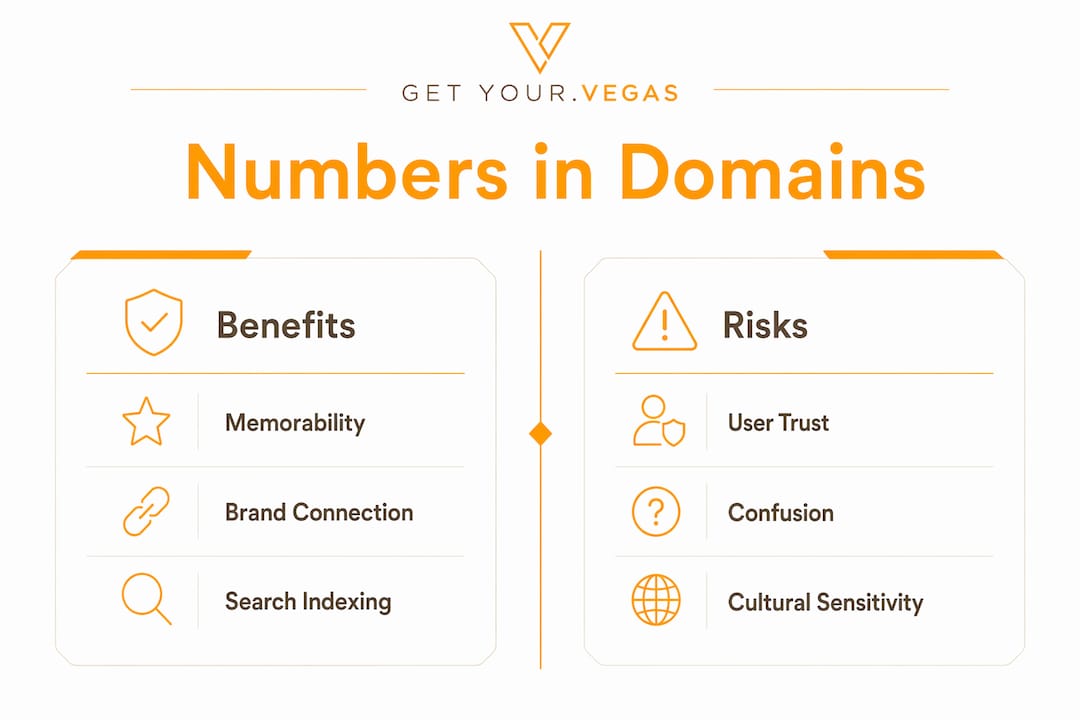
Simplicity wins every time. The cleaner your domain looks in a browser bar and a SERP listing, the better your click-through rate and the stronger your brand signal.
Why do cultural factors change the value of numeric domains?
Cultural numerology is one of the most underestimated factors in domain name strategy, especially for brands targeting international markets or investors buying domains as assets.
In Chinese-speaking markets, the number 4 sounds like the word for "death" in Mandarin and Cantonese. Domains containing 4 lose significant value in these markets, regardless of how short or memorable the domain might otherwise be. By contrast, the number 8 sounds like "prosperity," and sequences like 168 (meaning "road to prosperity") command strong premiums at auction.
"Serious domain investors consider culturally driven numeric premiums before acquisition. A six-digit .com containing no 4s and ending in 8 can sell for multiples of what the same length domain with a 4 would fetch in Asian markets."
This matters for American businesses too. If you sell products in China, Southeast Asia, or to diaspora communities in the United States, a domain containing 4 can undermine trust before a customer reads a single word of your copy. The same logic applies to other cultures with strong numerological traditions.
- China: 4 is unlucky, 8 is lucky, 168 signals prosperity
- Japan: 4 and 9 carry negative associations (death and suffering)
- Western markets: 13 carries mild superstition but rarely affects domain value significantly
- Domain investors: High-speed automated scanners now pre-check NS records to identify valuable numeric domains before competitors, factoring in cultural premiums as part of the acquisition logic
The practical takeaway for American brands is straightforward. If your growth plan includes any Asian market, audit your domain's numeric content before launch. A digit that feels neutral in the United States can actively repel customers in another market.
Key Takeaways
Numbers in domain names are technically equal to letters for DNS and SEO purposes, but their branding and cultural impact determines whether they help or hurt your business.
| Point | Details |
|---|---|
| Numbers are fully allowed | Digits 0–9 are valid in second-level domains under ICANN and RFC standards. |
| TLDs cannot be all-numeric | Only second-level domains can use numbers; top-level domains must include letters. |
| SEO impact is behavioral | Search engines index numeric domains equally, but user trust and CTR drive real results. |
| Cultural context changes value | Digits like 4 reduce domain desirability in Asian markets; 8 and 168 increase it. |
| Encode numeric IDs in URLs | Use tools like Sqids to hide database structure from competitors in your URL paths. |
My take on numeric domains after years in the space
Numbers in domains are one of those topics where the conventional wisdom is half right and half lazy. The standard advice says "avoid numbers because they confuse people." That is true for random digit strings. It is completely wrong for brands built around a number.
Think about what 7-Eleven, 1-800-Flowers, or 99designs have in common. The number is the brand. Stripping it out would not make those names clearer. It would erase the identity entirely. The mistake most businesses make is treating numbers as a fallback when their preferred name is taken, rather than as a deliberate brand choice from day one.
Where I see real damage is in domains that mix spelled-out words and digits without a reason. A domain like "best4you.com" forces the reader to decide whether "4" means "for" or the number four. That cognitive friction is small but real, and it compounds every time someone tries to recall or share your URL.
The cultural dimension is where most American brands get blindsided. A Las Vegas business targeting international visitors, particularly from China or Japan, needs to think about numeric associations the same way they think about color choices in logo design. A digit that feels neutral to you can carry strong meaning to your customer.
My honest recommendation: if a number is central to your brand story, put it in the domain and own it completely. If you are adding a digit just to get a shorter or available name, reconsider. The best domain names, numeric or not, feel inevitable once you hear them.
— Shawn
Your next domain move with Getyour
Choosing the right domain is one of the highest-leverage decisions a brand makes. Getyour specializes in .VEGAS domains that give Las Vegas businesses and entrepreneurs a distinct, location-anchored identity online.

Whether you want to lease a .VEGAS domain and test it as part of a campaign, or you are ready to make an offer on a premium numeric or alphanumeric name, Getyour has the inventory and the auction services to match you with the right property. Clients like WEDDINGS.VEGAS show exactly what a sharp domain does for brand recognition in a competitive market. If your brand belongs in Las Vegas, your domain should say so.
FAQ
Are numbers allowed in domain names?
Yes. Digits 0–9 are fully valid in second-level domain names under ICANN and RFC standards. The only restriction is that top-level domains (TLDs) cannot consist entirely of numbers.
Do numbers in a domain name hurt SEO?
Numbers do not directly hurt SEO. Search engines index numeric domains the same as letter-based ones, but user trust and click-through rates depend on how clear and branded the domain appears in search results.
What is the best practice for using numbers in domain names?
Use a number only when it connects directly to your brand identity, such as a founding year, a product count, or a price point. Avoid random digit strings that offer no memory hook or brand meaning.
How do cultural factors affect numeric domain names?
In Chinese-speaking markets, domains containing the number 4 lose value because 4 sounds like "death" in Mandarin. Numbers like 8 and sequences like 168 carry positive associations and command higher prices at auction.
Should I encode numbers in my website URLs?
Yes, if those numbers are database IDs. Exposing sequential numeric IDs in product or user URLs lets competitors estimate your database size. Tools like Sqids encode those numbers into opaque, URL-safe strings that protect your business data.