
For a short, high-intent campaign, an exact-match seasonal TLD beats a subfolder every time. For long-term catalog continuity, a subfolder wins. That's the rule. Here's how it maps to the TLDs you're actually choosing between:
- .holiday — broadest seasonal signal; fits multi-event retailers running year-round promotional windows
- .christmas — maximum intent clarity for December gift campaigns; narrow but powerful for that window
- .gift — works across Valentine's Day, Mother's Day, and the holiday season; strong for curated gift guides
- .party — ideal for event planners, nightlife brands, and New Year's Eve promotions
- .events — best for ticketed experiences, conferences, and local pop-ups with a defined date
- .sale / .shop / .store — commerce-first signals; use when the primary action is a transaction, not content
- .vegas — geo-intent plus lifestyle signal; the right call for Las Vegas businesses, event promoters, and brands running campaigns tied to the city's identity
The SEO trade-off is real but manageable. A new seasonal TLD carries zero domain authority on day one, so it depends on paid, email, and social channels to drive traffic. A subfolder on an established domain inherits that authority. Choose the seasonal domain when brand recall and channel amplification matter more than organic ranking.
Key Takeaways
Seasonal campaign domains deliver the highest ROI when campaigns are short, channel-amplified, and built for reuse across multiple annual windows.
| Point | Details |
|---|---|
| Match TLD to campaign intent | Use .christmas for December gifts, .gift across multiple seasons, .events for ticketed experiences, .vegas for Las Vegas campaigns. |
| Default to subfolders for organic | New seasonal domains start with zero authority; use them when paid, email, or OOH channels drive the traffic. |
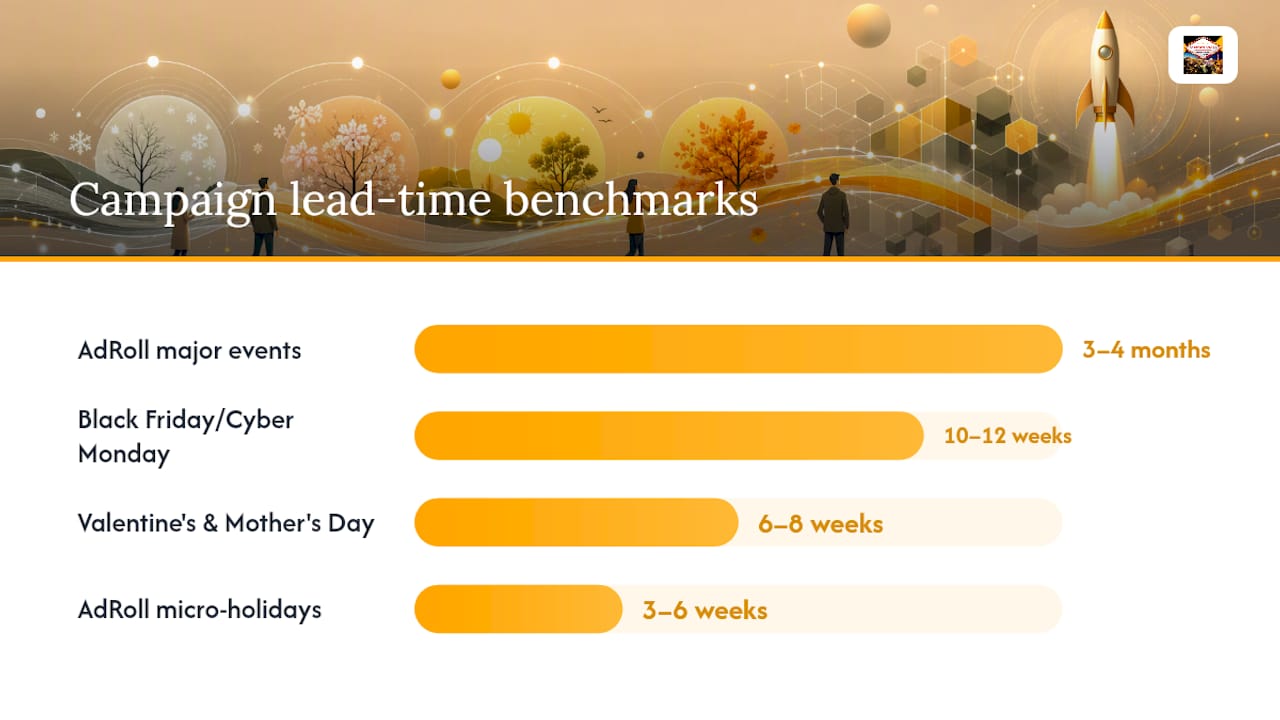
| Register 8–12 weeks early | BFCM needs 10–12 weeks of lead time; micro-holidays need 3–6 weeks per AdRoll's planning guidance. |
| Set time-based redirects | One campaign URL can route visitors through the full promotional arc using date and geo rules, reducing link bloat. |
| GET YOUR VEGAS for .VEGAS leasing | Lease or acquire a premium .VEGAS domain with expiration management and optional billboard tie-ins for Las Vegas campaigns. |
Table of Contents
- 1. Which seasonal TLD fits your campaign?
- 2. Seasonal domain vs. subfolder vs. subdomain: how to decide
- 3. How to register, build, and launch a seasonal domain
- 4. Naming, pricing, and trademark basics
- 5. Real examples and a .VEGAS campaign case study
- 6. Your pre-launch checklist for the final 72 hours
- 7. When a seasonal domain is actually worth it
- .VEGAS leasing for your next seasonal campaign
- Sources
1. Which seasonal TLD fits your campaign?
Each TLD below signals something specific to the visitor before they even click. Match that signal to your campaign's primary intent.
.holiday is the most flexible option in the group. It fits multi-event retailers, hospitality brands, and any marketer running a promotional calendar that spans Thanksgiving through New Year's. Setup is straightforward at most major registrars, and the TLD reads as friendly rather than transactional.
.christmas is narrow by design. That narrowness is the point. When your entire campaign is December gift-buying, the domain name itself does part of the selling. Outside that window, the domain sits idle, so factor that into your cost-per-active-day math.
.gift earns its place across multiple seasonal windows. A well-named .gift domain can run for Valentine's Day in February, Mother's Day in May, and the holiday season in December, making it one of the better investments in this list for brands with recurring gift-focused campaigns.
.party skews toward nightlife, event planning, and celebration brands. New Year's Eve promotions, bachelorette packages, and corporate event companies all fit naturally. AdRoll's seasonal marketing guidance notes that micro-holidays and niche events often drive higher engagement than broad public holidays for vertical brands, and .party is built for exactly that audience.
.events is the right call when there's a ticket, a date, and a venue. It signals a time-bound experience rather than a product, which sets visitor expectations correctly from the first click. Registration complexity is low; the bigger challenge is building enough authority before the event date.
.sale, .shop, and .store are transaction-first signals. Use them when the landing page's primary action is "buy now" rather than "learn more." Of the three, .shop and .store tend to have wider availability at retail pricing; .sale can carry premium pricing for short, high-value names.
.vegas is a geo-experience TLD with a lifestyle signal no generic extension can replicate. For Las Vegas businesses, event promoters, and brands running campaigns tied to the city, it communicates place and energy in a single word. Glossy's 2026 holiday marketing research highlights that CTV and AI-driven discovery are reshaping how campaign assets get found, and a memorable .vegas domain holds up across those channels in a way a generic URL does not.

Pro Tip: Reserve close spelling variants of your chosen domain at registration. A campaign driving TV or OOH traffic will generate type-in visitors who misspell the name. Redirect those variants to your primary domain before launch, not after.
2. Seasonal domain vs. subfolder vs. subdomain: how to decide
The default for most brands should be a subfolder. Use a seasonal campaign domain when the campaign is short, high-visibility, and channel-amplified enough to build recall without organic search.
Here's how the three options compare across the dimensions that matter most:
| Dimension | Seasonal domain | Subfolder | Subdomain |
|---|---|---|---|
| SEO authority | Starts at zero | Inherits root domain authority | Partial inheritance |
| Brand recall | High (exact-match, memorable) | Low (long URL) | Moderate |
| Tracking isolation | Clean by default | Requires careful UTM discipline | Moderate isolation |
| Speed to launch | Fast with a redirect | Fast | Moderate |
| Risk of domain decay | High if not renewed | None | None |
| Best for | Short, paid/social/OOH campaigns | Long-term catalog pages | Microsites with separate CMS |
Choose a seasonal domain when: your campaign runs 2–8 weeks, you're driving traffic via paid, email, TV, or OOH channels, and brand recall across those channels is a priority. Choose a subfolder when: the content will live permanently, organic search is the primary channel, or the campaign is an extension of an existing product category. Choose a subdomain when: you need a separate CMS or tech stack for the campaign but want some association with the root domain.
Pro Tip: When you retire a seasonal domain, set a 301 redirect from that domain to the closest equivalent subfolder on your main site before the domain expires. This preserves any backlinks the campaign earned and prevents a dead-end for anyone who bookmarked the URL. The domain migration SEO playbook covers the full redirect sequence.
3. How to register, build, and launch a seasonal domain
Register early. Build a minimal campaign-ready landing page. Configure tracking and redirects before any promotion goes live. In that order.
- Choose an ICANN-accredited registrar. ICANN's accredited registrar list is the authoritative source for verifying registrar legitimacy and whois transparency.
- Check availability and register. Search for your preferred name plus close variants. Register all of them in one session.
- Configure DNS and SSL. Point the domain to your hosting, then install an SSL certificate before any traffic arrives. A browser security warning on a campaign landing page kills conversions.
- Set up analytics and UTM parameters. Google Ads recommends building a separate seasonal campaign with its own budget, keywords, and landing pages so performance data stays clean and the campaign can be reactivated next year.
- Configure time-aware redirect rules. Time-based routing lets a single campaign URL route visitors to the correct landing page based on date and geo rules, covering the full arc from early access through clearance without changing your promoted URL.
- Test across devices and time zones. Run the full redirect chain on mobile and desktop, and verify that geo/time rules fire correctly across U.S. time zones.
- Stage a smoke test 48 hours before launch. Confirm every ad destination URL, email link, and social bio link resolves correctly.
Timing benchmarks: For Black Friday/Cyber Monday, register and begin building 10–12 weeks out. For Valentine's Day and Mother's Day, 6–8 weeks is workable. AdRoll recommends 3–4 months of lead time for major events and 3–6 weeks for micro-holidays. For a vanity URL campaign with .VEGAS, a one-day launch is achievable when the domain is already leased and the redirect is pre-configured.
Pro Tip: Set a calendar alert 60 days before your domain's expiration date. Losing a seasonal domain you've already promoted is expensive to recover from. Most registrars offer auto-renew, but verify it's active at registration, not after the fact.
4. Naming, pricing, and trademark basics
A good campaign domain name is short, readable aloud, and unambiguous when spoken on a podcast or TV ad. Aim for 15 characters or fewer in the second-level label. Avoid hyphens; they create hesitation in spoken promotion and confusion in type-in traffic.
Naming rules to follow:
- Lead with the intent word (the action or event), not the brand name
- Avoid homophones and alternate spellings that split type-in traffic
- Test the name by saying it aloud to someone unfamiliar with the campaign
- Check for event-specific domain naming patterns in your vertical before finalizing
Pricing reality: Retail registration for new TLDs like .holiday or .gift typically runs in the range of standard gTLD pricing at most accredited registrars. Premium names at the registry level and aftermarket or leased domains carry significantly higher costs. Leasing a premium .vegas domain, for example, gives you a pre-established name with existing recall potential without the full acquisition price. The domain acquisition strategy guide covers aftermarket dynamics in detail.
Trademark caution: Run a USPTO trademark search before you finalize any campaign domain name. A name that conflicts with a registered mark creates legal exposure regardless of which TLD you use. This is especially relevant for exact-match promotional names tied to product categories where trademark density is high.
An exact-match promotional domain reduces friction and increases shareability across channels, but only when the name is legally clear and genuinely memorable.
5. Real examples and a .VEGAS campaign case study
Exact-match campaign domains lift recall and CTR during promotional windows when the domain is promoted heavily across channels. Two patterns prove this consistently.
FreeTacoDay.com is the clearest example in the restaurant category. The domain name is the campaign. No tagline needed. Visitors who type it in already know what they're getting, which compresses the funnel from awareness to conversion.
Micro-holiday verticals show a similar pattern. A niche brand running a campaign tied to a specific industry event, say a trade show or a vertical awareness month, often sees stronger engagement from a purpose-built event domain than from a generic sale page buried in a subfolder.
Mini .VEGAS case study: A Las Vegas wedding venue leased a .VEGAS domain to run a Valentine's Day campaign. The objective was to capture high-intent search and social traffic from couples planning Las Vegas elopements. The domain was promoted across Instagram, Pinterest, and a targeted email sequence. Because the domain communicated both the service (weddings) and the location (.VEGAS) in two words, it required less explanatory copy in ad creative. The campaign's landing page was structured with explicit recipient signals and offer metadata, which aligned with the AI-mediated discovery patterns Glossy's 2026 research identifies as increasingly important for holiday campaign visibility.
A .VEGAS domain compresses your pitch. The location and the offer live in the URL itself, which means every impression, whether on a billboard, an Instagram story, or a CTV ad, carries the full message without a single extra word.
Lessons from the case study:
- Lease or acquire the domain at least 8 weeks before the campaign window
- Structure the landing page for AI discovery with explicit offer attributes and recipient signals
- Pair the domain with a billboard or OOH placement in Las Vegas to maximize geo-intent traffic
6. Your pre-launch checklist for the final 72 hours
Run this checklist in order. Assign each item to a named owner before the 72-hour window opens.
- DNS and SSL: Confirm the domain resolves correctly and the SSL certificate is active with no browser warnings.
- Canonical and robots.txt: Set the canonical tag to the primary campaign URL and confirm robots.txt is not blocking the page.
- Analytics and UTM parameters: Verify that all UTM-tagged URLs fire correctly in your analytics platform and that the campaign view is isolated.
- Ad destination tests: Click every ad destination URL in every active campaign and confirm the landing page loads correctly.
- Email and social links: Test every link in your pre-scheduled email sequences and social bio links.
- Mobile speed check: Run the landing page through Google PageSpeed Insights. A slow mobile load on a campaign page is a direct conversion loss.
- Geo and time routing tests: Trigger the redirect chain from multiple U.S. time zones to confirm date-based routing fires at the correct local time.
- Payment and shipping messaging: Confirm that any deadline-driven messaging (last-day shipping, offer expiration) is accurate and matches the redirect schedule.
- Data collection and consent: If the landing page collects email addresses or personal data, confirm consent language and opt-in mechanics are in place.
Fallback plan: If the domain underperforms in the first 48 hours, have a 301 redirect ready to route traffic to the closest subfolder equivalent on your main domain. Don't wait a week to make that call.
- Assign the smoke test to one person, not a committee
- Run the final check at 7 hours before launch, not 72
- Keep the rollback redirect pre-configured and tested before go-live
7. When a seasonal domain is actually worth it
The conventional wisdom says seasonal domains are a niche tactic for big brands with big budgets. That's wrong. The real filter is channel amplification, not budget size.
A seasonal campaign domain earns its cost when three conditions are true: your audience has high purchase intent during a defined window, your campaign runs across channels where a short, memorable URL gets seen repeatedly (TV, OOH, paid social, email), and you plan to reuse the domain next year. If all three apply, the domain pays for itself in recall and tracking clarity alone.
When only one or two of those conditions apply, a subfolder is the smarter call. Organic search is slow to reward a new domain, and a campaign that lives primarily in Google Shopping or a product feed doesn't need a separate URL to perform.
For Las Vegas campaigns specifically, .VEGAS is the one TLD where geo-intent and lifestyle signal combine in a way no generic extension can replicate. A local business running a New Year's Eve promotion, a wedding venue targeting elopement couples, or an event promoter driving ticket sales all benefit from a domain that says "Las Vegas" before the visitor reads a single word of copy. Measure the domain's ROI by tracking direct and branded search lift during the campaign window, then use that data to justify the renewal for next year.
.VEGAS leasing for your next seasonal campaign

GET YOUR VEGAS offers .VEGAS domain leasing, sales, and auctions built specifically for businesses that need a campaign-ready domain fast. If you're running a Las Vegas-tied promotion, whether it's a holiday sale, an event, or a year-round brand play, a leased .VEGAS domain gets you a premium, geo-intent name without the full acquisition cost. GET YOUR VEGAS also pairs domain leasing with optional billboard advertising in Las Vegas, so your campaign URL can run on a screen and a street corner at the same time. Expiration and renewal management is handled, so you don't lose the domain between campaign seasons. Lease a .VEGAS domain now, or make an offer on a specific name you want to own outright.
Sources
- Icann
- Create a seasonal campaign - Google Ads Help
- What is Seasonal Marketing? Strategies, Opportunities, and FAQs | AdRoll
- Holiday Campaign Routing: Black Friday Links That Turn into Cyber Monday Links Automatically
- Glossy Research: The 2026 guide to holiday marketing strategies, including A-Frame Brands, Mastercard and Ritual
- Atablefortwo