
Premium .VEGAS domain names typically cost anywhere from a few hundred dollars for a lease to $50,000 or more for a competitive auction bid. The right number for your business depends entirely on your acquisition route. Here is the fast breakdown. The smartest first move is to contact GET YOUR VEGAS for a valuation before you commit to any path.
Quick price ranges by acquisition route:
- Registry-reserved (DotVegas solicited list): Price not publicly listed; negotiated directly, often starting in the low-to-mid thousands
- Aftermarket brokered sale: Typically $1,000–$25,000+ depending on brandability and traffic
- Sealed-bid auction: Minimums can start at $50,000 for portfolio events; single-name floors vary
- Lease (GETYOUR.VEGAS programs): Recurring monthly or annual fees, often the lowest cash-flow entry point
Your action checklist:
- Identify the name you want and its current status (registry-reserved, aftermarket, or available for lease)
- Evaluate whether ownership or a lease fits your brand timeline and budget
- Engage GET YOUR VEGAS for a valuation or lease quote before making any offer
- Budget for broker, escrow, and transfer fees on top of the headline price
WEDDINGS.VEGAS is a real example of what a well-chosen .VEGAS name does for a brand. That kind of identity lock-in is exactly what the DotVegas registry and GET YOUR VEGAS have been building since the extension launched.
Key Takeaways
Premium .VEGAS domain prices range from recurring lease fees into five-figure auction minimums, and total acquisition cost always exceeds the headline price once broker, escrow, and legal fees are added.
| Point | Details |
|---|---|
| Price range by route | Registry-solicited names are negotiated; aftermarket sales typically run $1,000–$25,000+; auction minimums can reach $50,000. |
| Always budget for fees | Broker commission, escrow, transfer, and legal review can add 10–20% on top of the headline price. |
| Lease vs. buy decision | Leasing fits short timelines and limited budgets; buying outright is right when the domain is your core brand asset. |
| Auction entry discipline | Sealed-bid auctions require a firm ceiling set before you enter; factor all fees into that number before bidding. |
| GET YOUR VEGAS | Handles lease programs, auction representation, valuation, and escrow coordination for Las Vegas businesses. |
Table of Contents
- How is a premium .VEGAS domain price actually set?
- What should you expect at a .VEGAS auction?
- Leasing vs. buying: which cost profile fits your business?
- What drives a premium .VEGAS domain's price up or down?
- What extra costs should you budget beyond the headline price?
- What does the process look like from start to transfer?
- High-profile .VEGAS domain sales that show real market prices
- Red flags to watch for when acquiring a premium .VEGAS name
- What GET YOUR VEGAS sees working for Las Vegas businesses
- GET YOUR VEGAS: your direct path to a premium .VEGAS name
- Sources
How is a premium .VEGAS domain price actually set?
Not all .VEGAS names are priced the same way, and understanding the mechanism tells you whether a price is fixed or negotiable.
The DotVegas registry controls a reserved list of premium names. Rather than publishing buy-now prices, the registry solicits interested buyers from that list. Dot Vegas reported selling over $2 million worth of premium .VEGAS names while retaining roughly 1,000 additional reserved names for future solicitation. That means you will not find a price tag on many of the best names. You will need to express interest and negotiate.
Aftermarket brokered sales work differently. Here, a broker prices a name based on perceived brand value, comparable sales, and any existing direct traffic the domain already receives. Broker markup is built in, and the seller sets the floor.
Leasing produces a third pricing model entirely. Instead of a one-time purchase, you pay recurring fees over a defined term, with some lease agreements including a path to ownership. GET YOUR VEGAS structures these programs specifically for Las Vegas businesses that want brand-quality names without a large upfront outlay.
What shapes the price across all routes:
- Registry solicitation vs. open-market listing
- Broker involvement and commission structure
- Perceived brand value and commercial intent of the name
- Existing traffic or SEO history attached to the domain
Pro Tip: When a .VEGAS name is listed as "registry solicited," treat it as a negotiation, not a checkout. A broker who knows the DotVegas process can often open doors that a direct inquiry cannot.
What should you expect at a .VEGAS auction?
Auctions are where .VEGAS pricing gets dramatic fast. A documented sealed-bid .VEGAS portfolio auction set a stated minimum bid of $50,000, illustrating exactly how entry floors create step-function jumps in buyer cost. You do not inch toward that number. You either meet it or you are out.
Sealed-bid formats are winner-takes-all. You submit one number, and if it clears the reserve, you win. There is no back-and-forth. That structure rewards preparation and punishes impulse bidding.
Hidden reserve prices add another layer. A seller may advertise a minimum but hold a higher reserve privately. If bids clear the stated minimum but not the reserve, the auction fails and you have revealed your ceiling for nothing.
Budget items to factor in before you bid:
- Stated minimum bid (your hard floor)
- Broker or auction house commission (typically 10–20% of the winning bid)
- Escrow service fee (often 1–3% of transaction value)
- Registrar transfer fee (verify live at checkout)
Pro Tip: Set your maximum bid before the auction opens, then subtract broker and escrow fees to find your true ceiling. Enter the room knowing that number. Sealed-bid formats punish last-minute math.
For deeper bidding tactics, the auction bidding strategies guide from GET YOUR VEGAS covers sealed-bid mechanics in detail.
Leasing vs. buying: which cost profile fits your business?
Buying gives you permanent brand control and resale upside. Leasing gives you speed, lower upfront cost, and flexibility. Neither is universally better. The right answer depends on your business goals and cash position.
When leasing makes more sense:
- You need the name for a campaign or seasonal push, not a permanent brand anchor
- Your budget cap rules out a five-figure purchase
- You want to test conversion performance before committing to ownership
- You are a startup or new venue that needs brand presence now, not in six months
When buying outright makes more sense:
- The domain is your primary brand asset, not a campaign URL
- You want resale or collateral value in the name
- Long-term visibility in Las Vegas search and direct traffic is a core strategy
- You have the capital and a trademark-clear path to ownership
Decision checklist before you choose:
- Define your campaign timeline (12 months vs. 5+ years)
- Run a trademark search on the name before any offer
- Set a hard budget cap including all fees, not just the headline price
- Assess whether a lease-to-own option is available through GET YOUR VEGAS
- Confirm your DNS and marketing launch schedule so the timeline matches your needs
The Getyour are structured for exactly this decision. You can explore lease terms, cost structure, and application steps without committing to a purchase.
What drives a premium .VEGAS domain's price up or down?
Five factors move the needle more than anything else.
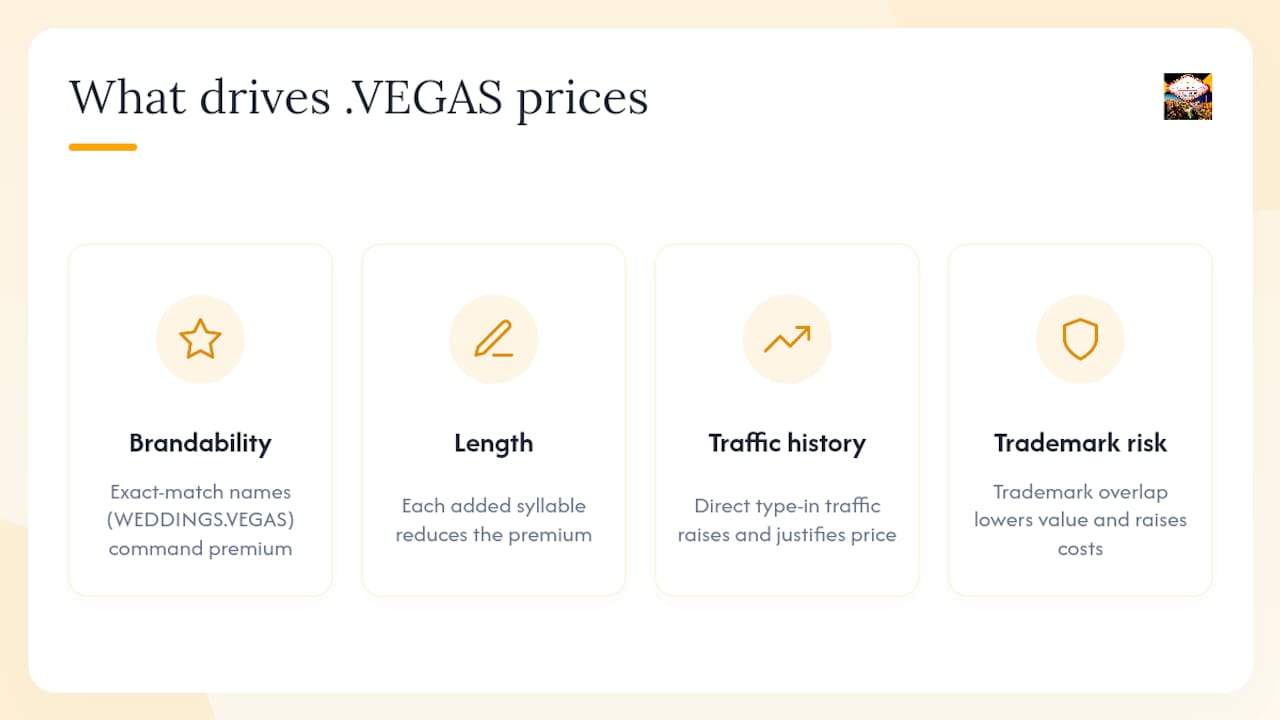
Brandability and exact-match terms sit at the top. A name like WEDDINGS.VEGAS is an exact-match generic for one of Las Vegas's biggest industries. One or two words tied to tourism, events, entertainment, or hospitality command a premium because the commercial intent is obvious and the audience is massive.
Length and memorability follow closely. Single-word .VEGAS names are rare and priced accordingly. Every syllable you add reduces the premium.
Traffic history matters more than most buyers expect. A domain that already receives direct type-in traffic carries built-in audience value. That traffic history raises the price, but it also justifies it. Local consumer channels like Vegas.com demonstrate the scale of demand that well-branded Las Vegas properties can capture.
Trademark risk cuts the other way. A name that overlaps with a registered trademark creates legal complexity and lowers marketability. It also raises your transactional cost because you will need legal due diligence before any transfer.
Vertical alignment is the sleeper factor. A name that aligns with a specific niche, such as sports betting, nightlife, or real estate, carries higher value for buyers in that vertical. Sites like VegasInsider.com show how repeat, niche-specific audiences build around Las Vegas verticals, and a matching .VEGAS name can funnel that traffic directly.
What extra costs should you budget beyond the headline price?
The headline price is rarely the total cost. Here is what you need to add.
| Fee Type | Typical Range | Notes |
|---|---|---|
| Broker commission | 10–20% of sale price | Applies to brokered sales and auction representation |
| Escrow service fee | 1–3% of transaction value | Protects both parties; non-negotiable for large transfers |
| Registrar transfer fee | Varies; historical observations at $10 | Verify live at checkout; median historical observation near $60 |
| Trademark/legal review | $1,000–$25,000+ | Strongly recommended before any premium acquisition |
| Lease admin fee | Varies by program | Included in some lease structures; confirm upfront |
| Marketing activation | Budget separately | DNS setup, redirect configuration, campaign launch costs |
Budget checklist for a full acquisition:
- Confirm headline price (bid, offer, or lease rate)
- Add broker/commission percentage
- Add escrow fee estimate
- Add legal due diligence cost
- Add registrar transfer and first-year renewal fee
- Set aside marketing activation budget
On taxes: domain acquisitions may be treated as intangible asset purchases under U.S. business accounting. Consult your accountant for deductibility and amortization treatment before finalizing your budget.
What does the process look like from start to transfer?
Knowing the timeline prevents surprises and helps you align a domain acquisition with a campaign launch.
- Discovery (1–3 days): Identify the name, check its status (registry-reserved, aftermarket, or leasable), and confirm no active trademark conflicts. The domain acquisition strategy guide covers this step in depth.
- Valuation (2–5 days): Get a broker or agency assessment of fair market value and comparable sales.
- Offer or bid submission (1–2 weeks): Submit a written offer, enter a sealed-bid auction, or initiate a lease application.
- Negotiation (1–4 weeks): Registry-solicited names and aftermarket sales often involve back-and-forth. Auctions are single-round.
- Escrow setup (1–3 days): Both parties fund and confirm the escrow account before transfer begins.
- Payment and transfer (3–14 days): Funds clear escrow, the registrar processes the transfer, and DNS is updated.
- Launch (1–2 days post-transfer): Configure DNS, set up redirects, and activate your campaign.
What lengthens a deal:
- Active trademark disputes or legal challenges
- Contested auctions requiring arbitration
- International payment clearance delays
- Registry-side transfer holds or verification requirements
High-profile .VEGAS domain sales that show real market prices
The most instructive data point in the .VEGAS market is the 2014 sealed-bid portfolio auction, where the stated minimum bid was $50,000 for a portfolio of premium .VEGAS names. That single event established that serious .VEGAS buyers operate in five-figure territory for portfolio-level acquisitions.
At the registry level, Dot Vegas reported over $2 million in premium name sales, with a reserved list of roughly 1,000 additional names held for future solicitation. That volume confirms an active, high-value market, not a novelty extension with thin demand.
WEDDINGS.VEGAS is the clearest single-name case study available. It demonstrates that an exact-match generic in a high-volume Las Vegas vertical produces measurable brand lift and customer acquisition. The name does the marketing work before a visitor even clicks.
Red flags to watch for when acquiring a premium .VEGAS name
Not every deal is clean. These are the warning signs that should slow you down.
Hidden costs are the most common trap. Always ask for a total cost breakdown before agreeing to terms.
Trademark conflicts can surface after you have already paid. Run a USPTO trademark search on any name before submitting an offer. A name that looks clear can still carry common-law trademark risk if a local business has been using it without registration.
Unverified traffic claims inflate aftermarket prices. Ask for verified analytics, not seller-reported numbers. Direct type-in traffic is valuable; claimed traffic without documentation is not.
Auction shill bidding is a real risk in unregulated formats. Work with a reputable broker or agency, and use escrow for every transaction above a few hundred dollars.
Registry transfer holds can delay your launch by weeks. Confirm the transfer timeline with the registrar before you finalize a campaign schedule that depends on the domain being live.
Lease terms with no ownership path can leave you paying indefinitely without building equity. Read the lease agreement carefully and confirm whether a lease-to-own option exists.
What GET YOUR VEGAS sees working for Las Vegas businesses
The buyers who get the most from a premium .VEGAS name share one trait: they treat the domain as a brand asset, not a URL. WEDDINGS.VEGAS is the clearest example. The name itself communicates the business, the location, and the audience in three words. That kind of identity clarity is worth real money in a market as competitive as Las Vegas.
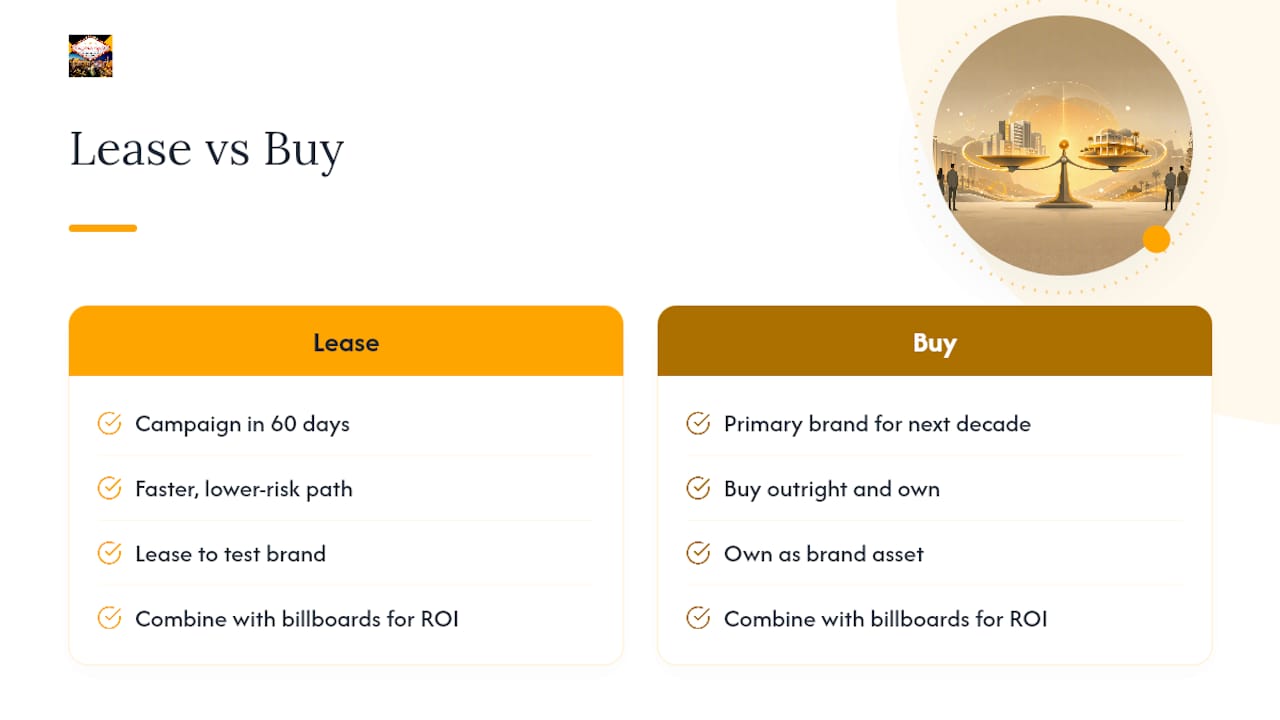
Most businesses that come to GET YOUR VEGAS are weighing the same question: lease now and test, or buy outright and own. The answer almost always comes down to timeline. If you need the name live for a campaign in 60 days, a lease is the faster, lower-risk path. If the name is your primary brand for the next decade, ownership is the only answer.
Combining a premium .VEGAS domain with Las Vegas billboard advertising creates a physical-to-digital funnel that very few local competitors are running. That combination is where the real ROI shows up.
Pro Tip: Bring a broker into any negotiation where the seller is a registry or a sophisticated aftermarket holder. Direct offers to a registry-reserved name often go unanswered. A broker with DotVegas relationships opens the conversation faster and at a better price.
GET YOUR VEGAS: your direct path to a premium .VEGAS name
You have done the research. You know the price ranges, the fee structure, and the acquisition routes. The next step is getting a real valuation on the specific name you want.

GET YOUR VEGAS has been working in the .VEGAS market since 2009, and the agency handles the full acquisition cycle: lease programs, buy and auction representation, valuation and make-an-offer facilitation, escrow coordination, and campaign launch support. You get one team managing every step, with full disclosure of broker and escrow costs before you commit to anything.
WEDDINGS.VEGAS is the kind of outcome GET YOUR VEGAS builds toward: a name that works as hard as your marketing budget. Whether you are ready to lease a premium .VEGAS name or want to make an offer on a specific domain, the intake process is fast and the first valuation conversation costs you nothing.
Drop us a line. Your .VEGAS name is waiting.
Sources
Use these sources to cross-check registry data, auction precedents, and registrar fee ranges before you finalize any budget.
- Dot Vegas sells $2m of premiums - Domain Incite
- .vegas delegation and historical market profile — TLDwise